Parks on the Air rewards an antenna that can travel easily, go up quickly, change bands without unnecessary complexity, and survive repeated setup and teardown. Those priorities help explain why the Wolf River Coils POTA antenna has become a familiar sight in parks.
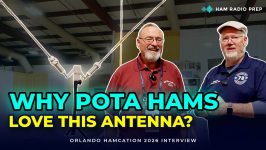
At Orlando HamCation 2026, Ham Radio Prep lead instructor Jim, N4BFR, spoke with Wolf River Coils co-owner Terry, N9AOT, about the company’s beginnings, adjustable loading coils, portable verticals, dipoles, compact SOTA configurations, and a 213-inch whip system designed for popular POTA bands.
The appeal is straightforward: Wolf River Coils uses a manually adjustable loading coil that lets an electrically short antenna resonate on multiple HF bands. Slide the tuning collar, verify the resonant point, and the same portable system can cover several bands without a motorized screwdriver mechanism.
What Is a Wolf River Coil?
A Wolf River Coil is a variable loading coil for HF antennas. The coil adds inductance to compensate when a whip or radiator is physically shorter than a full-size quarter wavelength on the desired band.
The operator changes the effective inductance by sliding a metal tuning collar along the coil. Moving that contact point changes how much of the coil is electrically active, shifting the antenna’s resonant frequency.
Wolf River Coils describes its design as an economical alternative to a motorized screwdriver antenna. There is no tuning motor or remote controller. The operator adjusts the collar by hand, making the system mechanically simple and easy to inspect in the field.
-
- Portable verticals with a whip, tripod, and ground radials
- Center-fed dipoles with a coil and whip on each side
- Vehicle installations using a suitable mobile mount
- Temporary, confined-space, and stealth installations
- Lightweight POTA and SOTA antenna kits
How Wolf River Coils Started
Wolf River Coils grew from the mobile operating experience of Gary, KB9AIT, and Terry, N9AOT. Both had tried multiple commercial and homebuilt mobile antennas while looking for a multiband HF solution that was simple to mount, easy to maintain, and more economical than many motorized alternatives.
The company’s early emphasis was mobile operation. Its visibility among portable operators increased after a Wolf River Coils system was used successfully during the 2016 National Parks on the Air program and later appeared in a 2017 QST article.
That exposure aligned the product with a growing style of operation: hams wanted portable HF antennas that could be carried to a park, assembled without a workshop, tuned across several bands, and packed away after the activation.
Why Wolf River Coils Work Well for POTA
Fast, Tool-Free Field Assembly
Many Wolf River portable systems use threaded sections, collapsible whips, tripod bases, and simple radial connections. Once the operator knows the system, assembly can be completed without special tools. That matters during a short activation, in changing weather, or when the operating position must be moved.
Manual Multiband Tuning
Sliding the collar lets the operator move the antenna’s resonance between bands. An antenna analyzer makes the process faster and more repeatable. Many operators mark useful collar positions after testing, then make a small final adjustment at the park.
Vertical and Dipole Configurations
A portable vertical offers a compact footprint and an omnidirectional pattern, but it needs an effective ground or radial system. A center-fed Wolf River dipole uses two loaded radiators and does not require ground radials, which can reduce trip hazards in busy parks.
The dipole still needs a safe support and adequate separation from people, structures, and power lines. “No radials” does not mean “no setup considerations.”
A Practical Size-to-Performance Compromise
Loading coils let operators use radiators shorter than a full-size antenna on lower bands. That makes transportation easier, although shortening an antenna generally reduces bandwidth and efficiency compared with a full-size resonant radiator.
Wolf River Coils systems are popular because many operators accept that compromise in exchange for portability, predictable tuning, and repeatable deployment.
Wolf River Coils Configurations Mentioned in the Interview

Otophone Loaded Dipole
The Otophone is a center-fed dipole system using two whips and two coils. It can be installed for portable, temporary, or permanent use. For a crowded park, eliminating ground radials can simplify the footprint. The tradeoff is that the dipole needs a suitable center support and clear space for both loaded elements.
Take It Along Portable Vertical
The Take It Along, or TIA, combines a Wolf River coil, tripod-style base, telescoping whip, and ground radials. The larger Silver Bullet 1000 configuration is designed for broader coverage, while Mini-based systems trade some lower-band capability for reduced size and weight.
213-Inch Whip With the Sporty Forty
A fully extended 213-inch whip is close to a quarter wavelength on 20 meters and can operate on 20 meters without a loading coil when installed appropriately. Shortening the telescoping whip allows adjustment for higher-frequency bands.
Adding the Sporty Forty coil at the base makes the long whip usable on 40 meters. This combination appeals to POTA operators who want common daytime bands plus 40-meter capability without using a general-purpose loading coil on 20 meters.
SOTA Special and Higher-Power Options
The SOTA Special pairs a compact coil, tripod, radials, and shorter telescoping whip for operators who value packed size and weight. Wolf River Coils also offers higher-power models for operators whose transmit levels exceed the standard ratings. Always choose by mode as well as peak transmitter output.
Power Ratings Matter
The standard Wolf River coils are currently rated for:
-
- 100 watts SSB
- 50 watts CW
- 20 watts digital
The Sporty Forty is currently listed for 200 watts SSB, 100 watts CW, and 75 watts digital. Higher-power models have different limits. Check the instructions for the exact coil you own before transmitting, especially during FT8, RTTY, or another high-duty-cycle mode.
How to Set Up a Wolf River Coils POTA Antenna
-
- Choose a safe location. Stay well clear of overhead power lines and position the antenna where a fall cannot reach energized wires.
- Assemble the base. Install the tripod or approved mount on stable ground.
- Deploy the radials when using a vertical. Spread them away from foot traffic and mark them when necessary. A loaded dipole does not use ground radials.
- Attach the coil and whip. Follow the instructions for the specific configuration and secure every threaded connection.
- Set the approximate band position. Use known collar marks or the manufacturer’s tuning guidance.
- Measure resonance. Use an antenna analyzer or low-power SWR measurement, then adjust the collar or whip length.
- Confirm the power rating. Match transmitter power and operating mode to the published limit.
- Recheck stability. Wind, soft soil, people, and pets can change an otherwise safe deployment.
Tuning Tips for Faster Activations
-
- Tune and document the antenna at home before the first park activation.
- Record collar positions for each band, but expect small changes with location and radial layout.
- Keep the same whip length and radial arrangement whenever possible.
- Start measurements at low power and move the collar in small increments near resonance.
- Clean and inspect the coil contact area so the collar makes a reliable connection.
- Recheck SWR after moving the antenna or changing its physical configuration.
An external antenna tuner can transform impedance at the radio, but it does not correct every loss in an inefficient or poorly installed antenna. Adjusting the antenna close to resonance first is usually the better field practice.
Tradeoffs to Consider Before Buying
-
- Manual band changes: You normally need to reposition the collar or whip.
- Narrower bandwidth on lower bands: Electrically short antennas may need retuning after a significant frequency change.
- Radials for vertical operation: A vertical depends on its counterpoise or ground-plane system.
- Reduced efficiency when shortened: A compact loaded antenna generally sacrifices efficiency compared with a full-size resonant antenna.
- Physical height: A 213-inch whip becomes almost 18 feet tall when deployed.
- Mode-specific limits: Digital operation may require a lower power setting than SSB.
Is a Wolf River Coils Antenna Right for Your POTA Kit?
A Wolf River Coils system is worth considering if you want adjustable multiband coverage, minimal-tool assembly, a smaller packed size, vertical and dipole options, and repeatable park deployment after some tuning practice.
If maximum efficiency on one band is the priority, a full-size resonant wire antenna may be a better choice. If you cannot deploy wires or need a small ground footprint, a loaded vertical may be more practical. The best POTA antenna is the one that fits the park, your bands, your power level, and the way you actually operate.