Parks on the Air activations can become familiar quickly: unpack the radio, spread out the ground plane, raise the mast, make contacts, and repeat. But familiarity can also create one of the biggest risks in POTA safety—moving through a routine without pausing to look up.
Ham Radio Prep lead instructor Jim, N4BFR, shares the story of an experienced POTA activator whose ordinary setup turned into a life-threatening electrical incident. The operator survived, but the sudden burst destroyed the radio and ground-plane blanket, burned a hole through the mast, and severed the end of the coax. The equipment loss was approximately $1,500. The outcome could have been far worse.
What Happened During This POTA Activation?
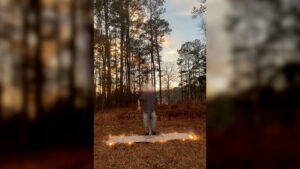
The operator was not brand-new to portable radio. Since the summer of 2025, the ham had completed more than 50 activations across over a dozen parks. On this morning, the operator returned to a familiar location for an early activation.
As daylight arrived, the operator raised a vertical antenna mast positioned on a mesh ground plane. It was a process performed many times before. During this setup, however, the mast contacted an overhead power line.
The operator was fortunate to escape physical injury. The event still caused extensive damage, and the near-miss carried a clear message: experience does not eliminate risk. A familiar park, a practiced routine, changing light, fatigue, distraction, or a slightly different setup position can be enough to hide a deadly hazard in plain sight.
The operator chose to share the footage anonymously so other hams could learn from it. The goal was to help everyone—not only new operators—remember to be safe.
Why Overhead Power Lines Are So Dangerous
An antenna mast does not need to be metal to create a dangerous situation. Moisture, dirt, carbon fiber, attached wire, coax, guy lines, and other materials can provide or help create an electrical path. Electricity may also arc across an air gap, so “almost touching” is not a safe plan.
The Occupational Safety and Health Administration advises people to assume that overhead wires are energized at lethal voltages and to survey the area before handling long objects. OSHA’s general electrical-safety guidance says to stay at least 10 feet (3 meters) away from overhead wires. Required clearances increase with voltage, and OSHA training material advises staying 20 feet away when the line voltage is unknown.
For a portable antenna, distance should account for the entire extended mast and its fall radius. If the antenna tips in any direction, no part of the mast, radiator, wire, coax, or guy system should be able to enter the danger zone around a power line.
The POTA Antenna Safety Check to Use Every Time
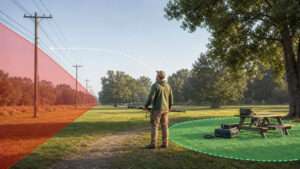
The essential POTA safety rule: Before you raise an antenna, extend a mast, launch a line, or handle any long object, stop and look for overhead power lines. Choose a setup area where the antenna cannot reach a wire—even if the mast falls.
Use this short check before setup and again before teardown. Repeating it every time makes safety part of the activation rather than an afterthought.
1. Stop Before Unloading the Antenna
Do not let excitement about a new park or a short activation window rush the site survey. Leave the mast packed while you inspect the area.
2. Look Up—and Scan a Full Circle
Stand where you intend to place the antenna and slowly scan 360 degrees. Look for distribution lines, service drops to buildings, lines hidden by trees, and wires that are difficult to see against the sky. Repeat the check from another angle.
3. Measure the Fall Radius
Consider the full length of the extended mast, antenna, and anything attached to it. Choose a position where a fall in any direction still leaves a generous buffer from every overhead wire. Ten feet is a common minimum clearance for lower-voltage contexts, not a target; greater distance may be required, and more separation is always the safer choice.
4. Check Changing Conditions
Wind, rain, darkness, uneven soil, passing vehicles, pedestrians, and weak anchor points can turn a stable setup into an unstable one. If conditions change, lower the antenna and reassess.
5. Use a Second Person When Possible
A spotter can watch the top of the mast while the operator focuses on the base. Agree on simple commands such as “stop,” “lower,” and “clear.” The person raising the mast should stop immediately if the spotter calls out a hazard.
6. Never Assume a Line Is Insulated or Inactive
Treat every overhead wire as energized. Do not rely on the appearance of the line, nearby tree cover, or the fact that it serves a small building.
7. Repeat the Survey During Teardown
Many operators focus on setup and relax once the activation is over. Teardown can be just as dangerous, especially when people are tired or trying to leave quickly. Lower the mast in a controlled direction while maintaining the same power-line clearance used during setup.
A 60-Second POTA Safety Checklist
Before raising or lowering your antenna, confirm:
If any answer is uncertain, move the station. A less convenient operating position is always better than an unsafe one.
Safety Is Not Just for New Ham Radio Operators
New operators need clear guidance, but repetition matters for experienced hams too. Familiar tasks often feel less risky precisely because we have completed them without incident. That is why a simple, consistent checklist is valuable: it protects us when confidence, habit, or distraction might otherwise take over.
Ham Radio Prep’s power-line and tower safety lesson emphasizes planning ahead and keeping antennas clear of overhead electrical wires. The ARRL similarly encourages operators to plan work carefully, learn what can go wrong, and make safety part of every amateur radio activity.
This is not about making portable operation intimidating. It is about preserving what makes POTA enjoyable: getting outside, experimenting with radio, and returning home safely.
Share This POTA Safety Message With Your Club
The video was intentionally kept short enough to show at an amateur radio club meeting. Play it before the next group activation, Field Day, antenna workshop, or new-member session. Then ask one practical question: What will our group do every time before a mast goes up?
A two-minute conversation can create a shared habit. A shared habit can prevent the next close call.
Before your next activation, remember the message from one ham who was given another chance: look up, slow down, and make safety the first contact of the day.
Frequently Asked Questions About POTA Safety
OSHA uses 10 feet as a minimum clearance in common lower-voltage contexts, with greater distances required at higher voltages. When voltage is unknown, OSHA training material recommends staying 20 feet away. For portable antennas, also account for the mast’s full fall radius so no component could enter the clearance zone.
Do not treat any portable mast as safe around power lines. Contamination, moisture, carbon fiber, attached wires, coax, and other components can conduct or help create a path for current. Electricity can also arc without direct contact.
Yes. Fatigue, darkness, wind, and rushing can increase risk during teardown. Recheck the surroundings, use a controlled lowering direction, and keep the same clearances used when raising the antenna.
Do not touch the antenna, mast, coax, vehicle, or nearby equipment. Keep everyone away and call emergency services and the electric utility. Assume the line and everything connected to it remain energized until the utility confirms otherwise.
Stop and look up before raising, lowering, or launching anything. Then confirm the complete antenna system cannot reach a power line—even if the mast falls.