Most students learn about space through books and videos. Some get to ask an astronaut a question and hear the answer come back over the radio.
That’s the experience ARISS, or Amateur Radio on the International Space Station, brings to schools around the world.
We spoke with Frank Bauer, KA3HDO, ARISS International Chair, about how these conversations happen, why they matter, and where amateur radio could go next. The possibilities reach beyond the space station.
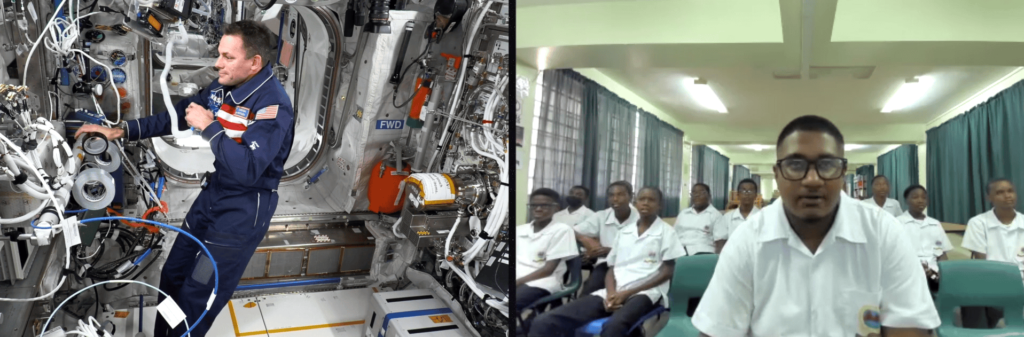
Screenshot from “Students from the Caribbean and Central America Speak to the International Space Station.” Video produced by Pacifico Risk Communications, available through the NASA Image and Video Library.
What Is ARISS?
ARISS gives students the opportunity to speak with astronauts aboard the International Space Station through scheduled amateur radio contacts. A typical conversation lasts about ten minutes, with students taking turns asking questions.
They might ask what sleeping in space feels like, how astronauts conduct experiments, or what Earth looks like from orbit. Hearing the answers from someone who is actually there makes the experience personal.
According to Bauer, ARISS supports roughly 60 to 100 school contacts each year. Behind each one is a team of educators, radio volunteers, and students preparing for a brief but memorable conversation.
If you’re new to the hobby, our guide to what ham radio is explains how it makes connections like these possible.
The Learning Starts Before the Contact
The astronaut conversation is the moment everyone looks forward to, but much of the learning happens beforehand.
Bauer described schools spending four to six months preparing. Students explore radio communication, space research, and the science behind reaching a station moving through orbit.
There’s a practical reason to learn how antennas work when your class is preparing to use one to reach an astronaut. Questions about radio waves and orbital motion become part of a project students want to understand.
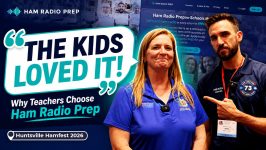
To help bring that learning into more classrooms, Ham Radio Prep for Schools program offers free access to our Technician License course for qualified educators and their students. Schools can apply to give students a way to explore radio communication, electronics, and antennas while preparing for their ham radio license exam.
Teachers can also build on that curiosity with NASA’s educator resources and ESA’s Teach with Space activities, which offer materials for bringing space topics into classroom lessons.
The experience can stay with students well beyond school. Bauer shared that some former participants now work in the space industry, including at NASA and the European Space Agency.
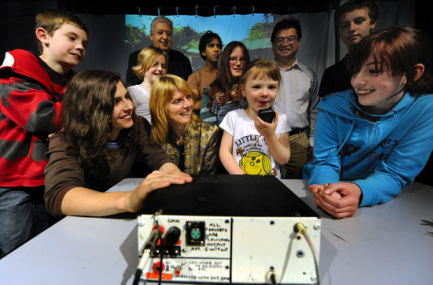
Image source: ARISS (Amateur Radio on the International Space Station).
How Can a School Participate in ARISS?
Schools have more than one way to connect with the ISS.
A direct contact uses an amateur radio station at the school to establish the radio link. Local ham radio operators can help set up the equipment and introduce students to the technology. ARISS provides ground station recommendations and preparation resources for participating teams.
Another option is a telebridge contact. A dedicated ARISS ground station elsewhere makes the radio connection, while students join through a telephone link.
Selected organizations receive guidance from an ARISS Technical Mentor. The ARISS educational contact guide explains the available arrangements.
Ready to explore a contact for your school? Start with the regional application information to find the appropriate process for your location.
What Comes After the Space Station?
ARISS is also looking ahead to the next generation of spaceflight.
In our conversation, Bauer explained that the organization has been working with commercial astronauts and discussing opportunities with companies developing future space stations. That work fits into a broader shift toward commercial destinations in space.
There’s already experience to build on. In its March 2026 update, ARISS reported supporting amateur radio activities on four Axiom Space missions to the ISS and the Fram2 mission. Readers can explore the research and outreach activities of the fourth Axiom flight on the official Axiom Mission 4 page.
The goal is to keep these educational connections going as human spaceflight evolves. ARISS outlines its work toward future opportunities in its Beyond the ISS update.
Could Ham Radio Reach the Moon?
One of the most exciting parts of our conversation was Bauer’s discussion of lunar possibilities.
He described ideas for amateur radio equipment in lunar orbit, on the Moon’s surface, or aboard a rover. One possibility would let students receive images transmitted from a lunar mission.
These are ambitions being explored, with technical work and mission planning still ahead. Bauer’s approach is to begin with smaller experiments, learn from them, and gradually develop more capable systems.
For anyone who enjoys building antennas or trying to receive a distant signal, that’s an exciting challenge to imagine. Students curious about the destination can explore lunar terrain and mission data through NASA’s interactive Moon resources.
Bring Ham Radio Into Your Classroom
An astronaut contact can give students a reason to explore radio long after the conversation ends.
Through Ham Radio Prep for Schools, accepted educators can receive free classroom access to our Technician License course. Students can learn radio fundamentals while preparing for their amateur radio license exam.
For teachers, it’s a way to turn excitement about space into practical lessons about electronics, antennas, and communication. For students, it could be the beginning of a hobby they carry into adulthood.
You can also explore ARISS’s information about receiving signals and contacting the ISS to see the different activities its amateur radio equipment can support.
Ready to begin? Learn how to get your ham radio license with Ham Radio Prep.