Welcome back. In this lesson, we’ll dive deeper into propagation – how radio waves interact with the atmosphere and travel through space.
This can be everything as simple as direct radio-to-radio communication through line of sight, or even bouncing your signals off the moon.
Auroral Backscatter
You’ve probably heard of the Northern lights, aka Aurora Borealis, which is a beautiful effect in the sky caused by charged particles from the sun, especially when the sun has a solar flare or coronal mass ejection.
However, you probably didn’t know that ham radio operators can bounce their signal off the Aurora like a giant mirror in the sky to send signals much further.
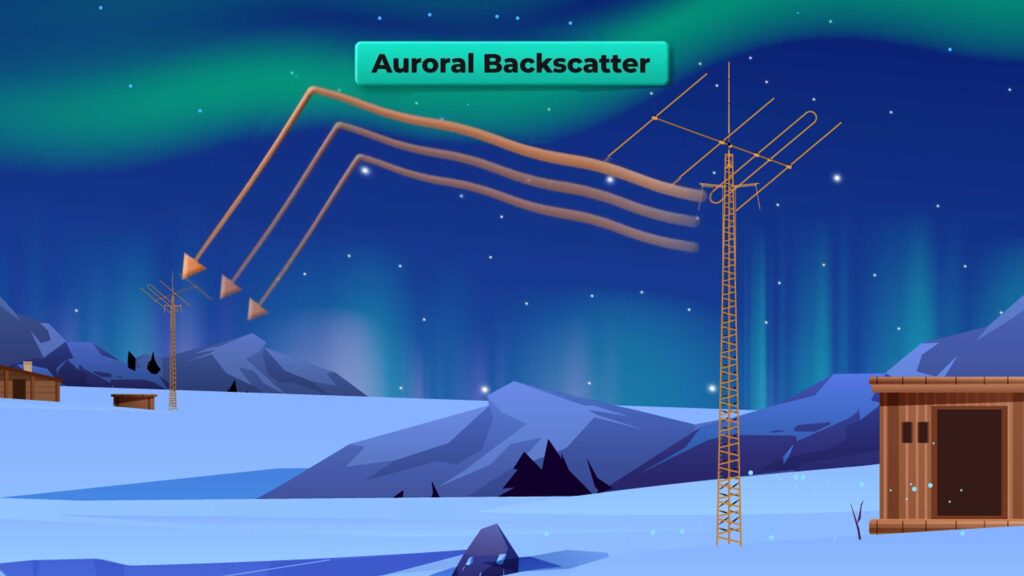
It’s called Auroral Backscatter, and it works best on the 6-meters and 2-meters bands, but these signals don’t sound like normal signals.
VHF signals received via auroral backscatter are distorted, with a characteristic raspy sound. It’s a very distinct, and sometimes almost ghostly sound.
Tropospheric Ducting
Another special type of propagation is called tropospheric ducting, which is caused by temperature inversions in the atmosphere. You can imagine it like warm air sitting on top of cool air, forming an air duct in the atmosphere that helps carry your signal.
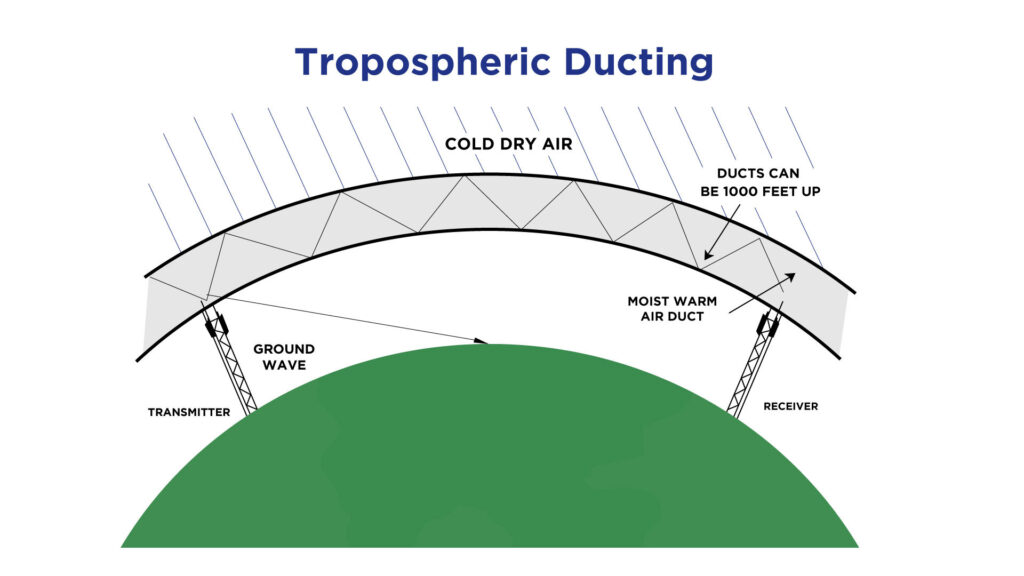
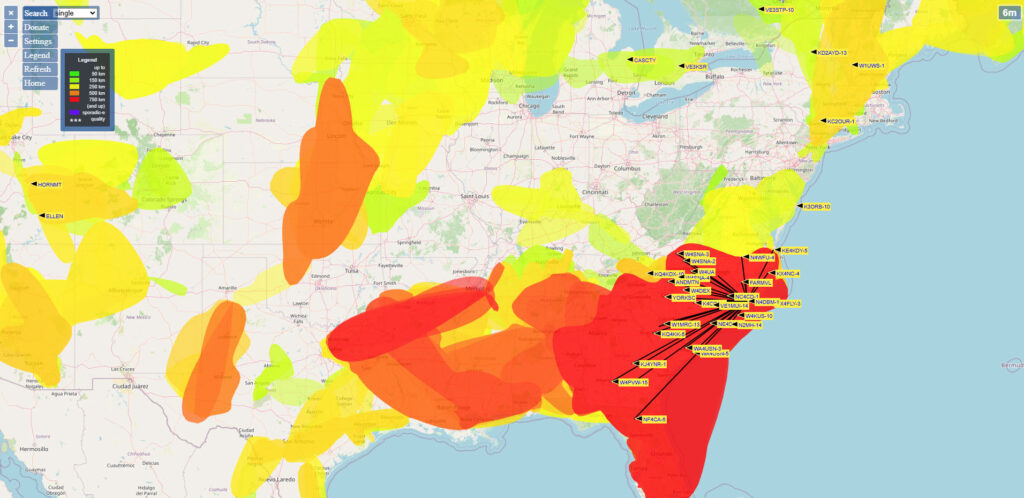
Tropospheric ducting can carry VHF and UHF signals over 300 miles regularly, making it a fun and exciting option for mid-range communications when conditions are right. Maps like these help hams track when the conditions are right, which we call a band opening.
Knife Edge Diffraction
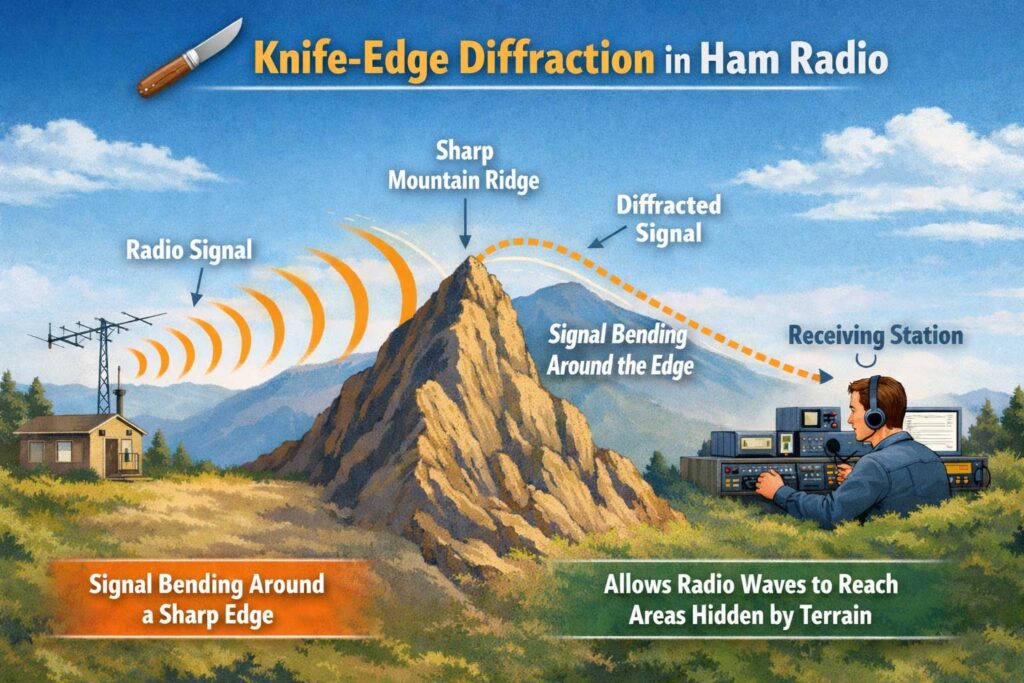
To get VHF or higher signals past physical obstructions, we can use knife-edge diffraction.
You can imagine this like signals bouncing off the sharp edge of the side of a building, like the sharp edge of a knife.
Meteor Scatter
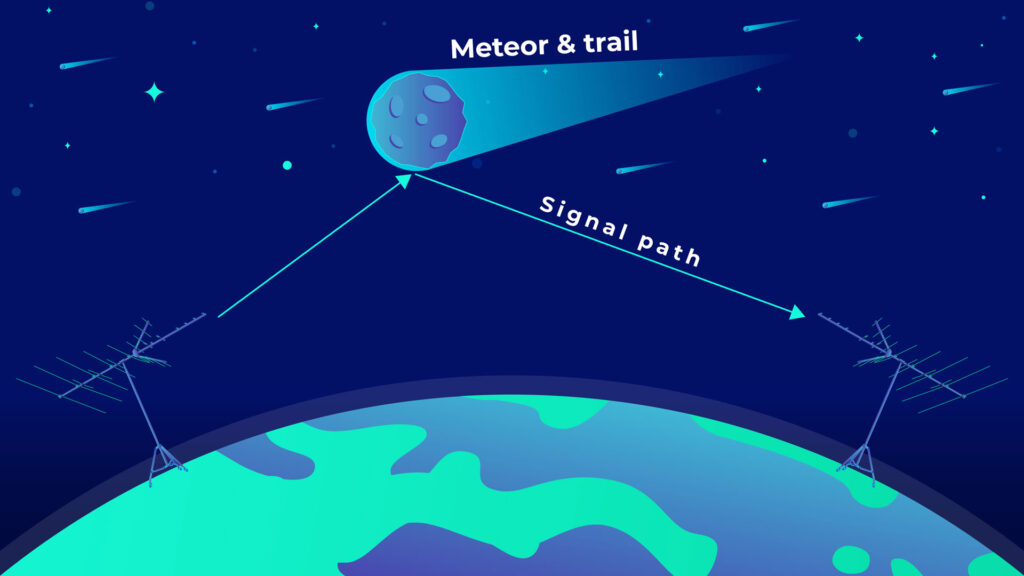
You can also reflect your signal off objects in the sky, like meteors. That’s called meteor scatter, and 6 meters is the VHF band most suited for it.
F region propagation
You may remember that on HF, you can bounce your signals off the ionosphere. There are actually different layers of the ionosphere. From lowest to highest, they are the D layer, the E layer, and the F layer, which has two parts: F1 and F2.
Each level reflects HF signals differently, depending on the band and the time of day.
The F region is the highest and most important atmospheric level for ham radio.
During the day, the sun charges the F layer and makes it possible for long-distance contacts on the 10-meters band.
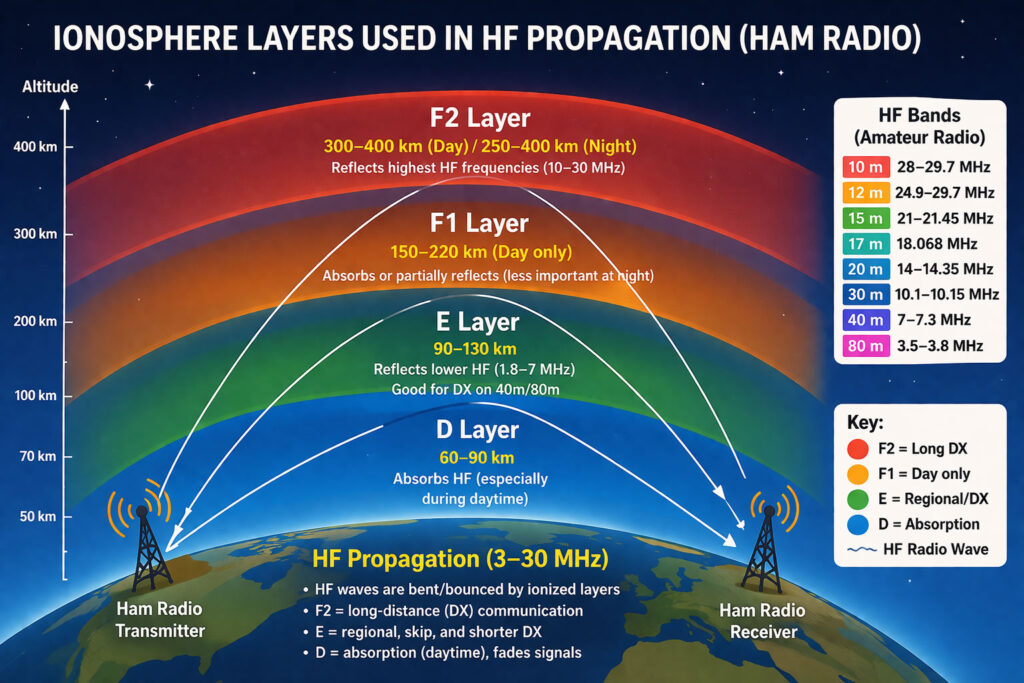
On the exam, the correct answer for the best time for long-distance 10-meters propagation is from dawn to shortly after sunset during periods of high sunspot activity. Don’t get confused here – from dawn to shortly after sunset just means during the daytime, and you want high sunspot activity to charge the F layer.
At the peak of the sunspot cycle, when the sun has the most sunspots, the F region can even support long-distance communications on 6 and 10 meters.
Sporadic E
While the F layer of the atmosphere is key for long-range communications, the E layer, which is below it, can be used as well, but not as reliably.
Normally, the E layer is too thin to reflect signals. But sometimes random clouds of intense ionization form in the E region, called Sporadic E. Sporadic E propagation is associated with occasional strong signals on the 10-, 6-, and 2-meter bands beyond the radio horizon.
The keyword here is occasional – Sporadic E is not reliable, it is occasional, aka sporadic.
Distortion and Interference
There are also times when propagation doesn’t go as planned, leading to distortion or interference. Multi-path propagation is one example.
Multipath propagation
Multi-path propagation happens when a signal takes multiple paths to the receiver, arriving at different times – like a messy echo in an empty room.
If you’re doing digital transmissions like DMR voice, when multipath propagation creeps in, error rates are likely to increase. That could cause parts of words or whole sentences to be lost. You can hear errors at the beginning of this DMR transmission.
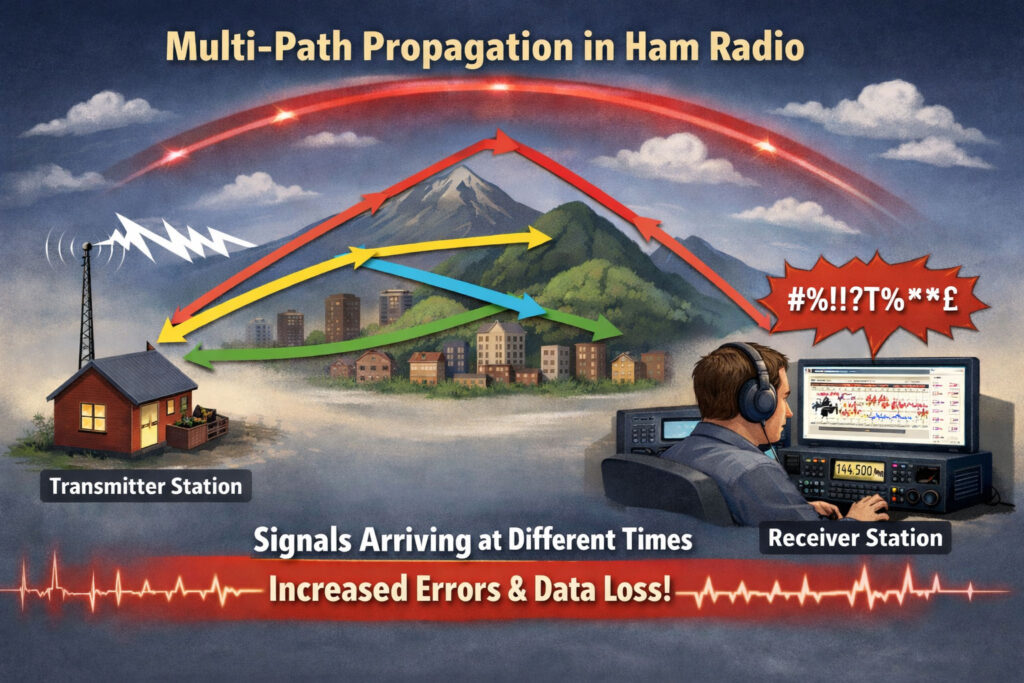
This isn’t just when using digital modes, either; it can impact VHF FM and SSB communications as well. On VHF, you’ll see that multipath propagation cancels or reinforces signals when an antenna is moved only a few feet.
Multipath propagation can also cause “picket fencing.” Picket fencing is a rapid flutter on mobile signals due to multipath propagation. You might hear this on a friend’s signal as they are driving down the road while talking to you on the radio.
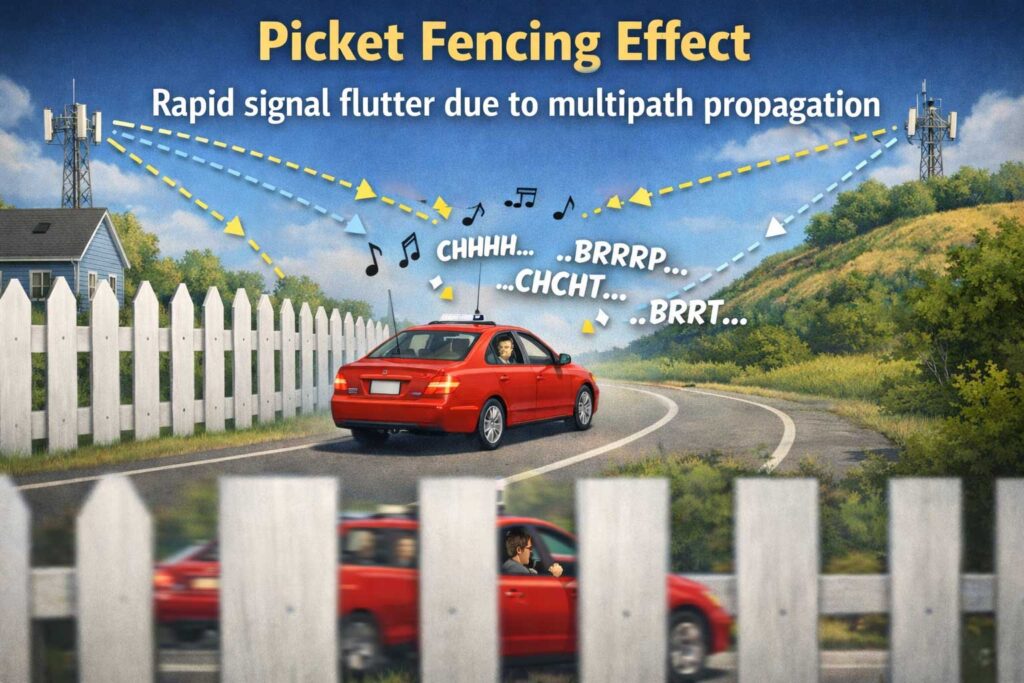
It’s called picket fencing because the rapid flutter is like hearing signals through the holes in a picket fence while you drive by.
Multipath also affects HF signals propagated by the ionosphere. Random combining of signals arriving via different paths is a likely cause of irregular fading of signals from the ionosphere.
Vegetation
Let’s say you’re operating from a dense forest – will the trees and vegetation affect your signal?
It all depends on the frequency – UHF and microwave signals are mostly affected. It gets worse as you go higher, and it becomes a significant issue on frequencies above 400 MHz. On UHF and microwave frequencies, vegetation absorbs signals, leading to poor reception of weak signals. Pine needles are a specific problem for the 13-centimeter band around 2.4 GHz because their length matches the wavelength, causing significant absorption.
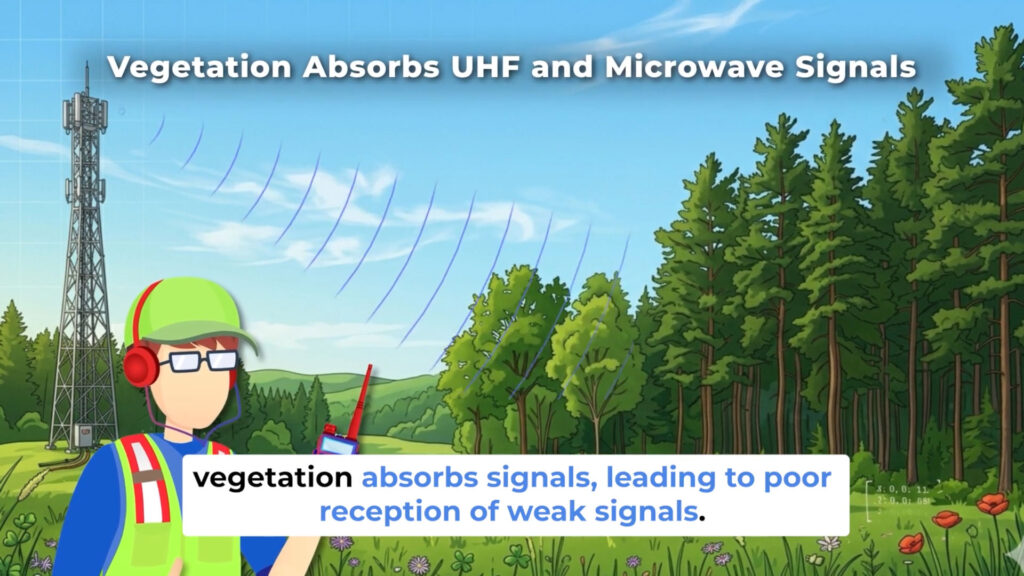
On HF frequencies, vegetation isn’t as much of a factor.
Weather conditions
Weather can also affect your ham radio propagation.
Hams usually like sunny days when the sun is sending a higher solar flux to charge up the atmosphere and help with propagation.
The good news is that fog or rain has little effect on 10-meter and 6-meter signals.
However, precipitation can decrease the range at microwave frequencies. Those little raindrops and snowflakes are just the right size to interfere with the microwave range.
Lesson recap
In this lesson, we took a deeper dive into propagation. You learned how the Northern lights aren’t just a beautiful effect in the sky, but can carry VHF signals, creating a characteristic raspy sound. You learned about various ways of carrying your signal, such as tropospheric ducting, knife-edge diffraction, and even meteor scatter. You learned about reflecting your signal of the F region and Sporadic E. Finally, you learned about distortion and interference caused by multipath propagation, picket fencing, and absorption by weather and vegetation.