The Three Big Frequency Ranges
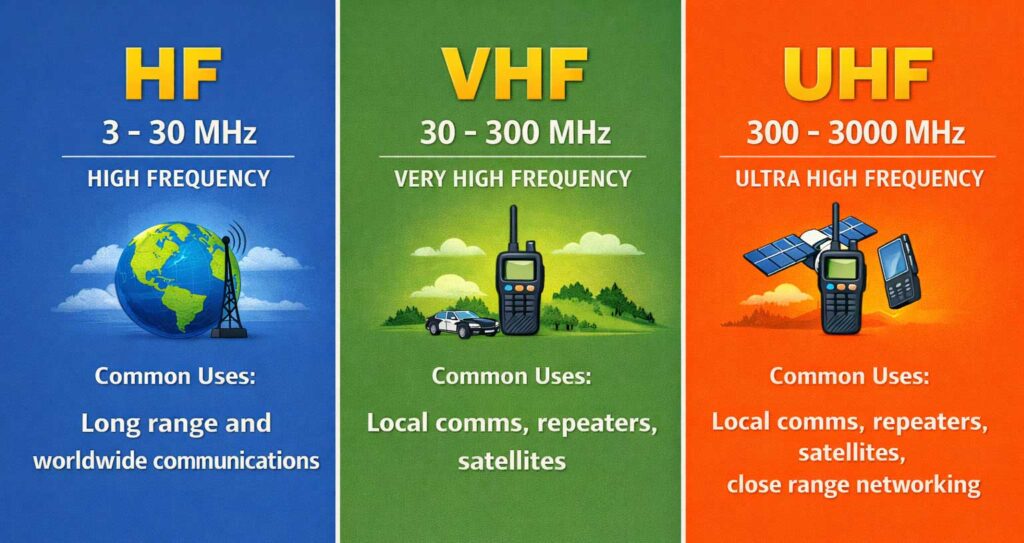
In this lesson, we’ll take a deeper look into how radio waves travel, which depends a lot on the frequency you are using. Let’s start by defining the three big frequency ranges in ham radio:
- HF (high frequency): is from 3 to 30 MHz
- VHF (very high frequency) is from 30 to 300 MHz
- UHF (Ultra High Frequency) is from 300 to 3000 MHz
Intro to Propagation
In ham radio, your radio waves can travel across your city or town, across your state, or even around the world. It all depends on the atmospheric conditions and what frequency you are using. How the radio waves travel is called propagation.
When you first get your Technician License, most of your privileges are on VHF and UHF, which is usually best for local communications because they are limited by the radio horizon.
Imagine if you and a friend are standing on opposite sides of a large field with your radios. Looking out across the field as far as you can see is called the visual horizon.
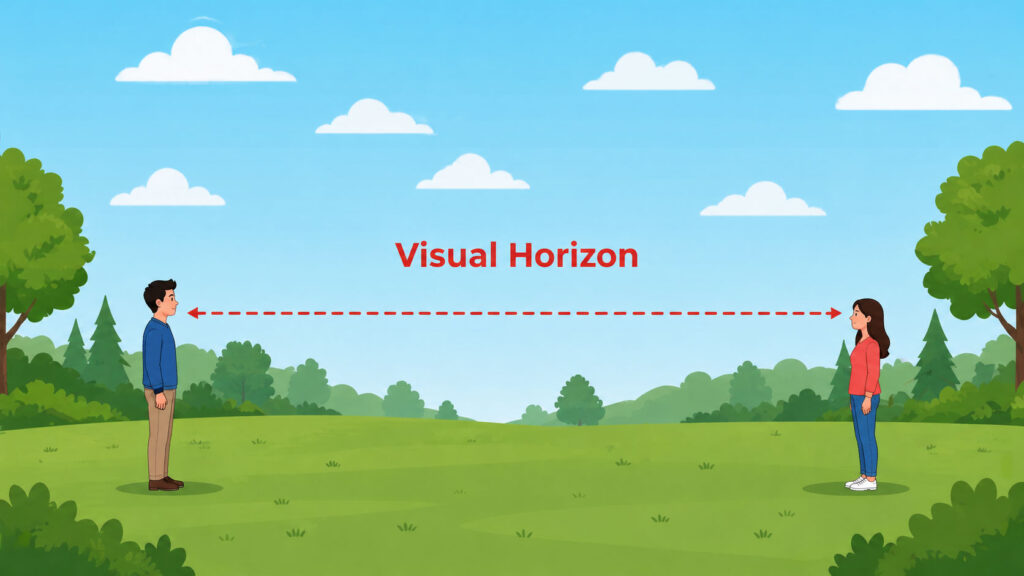
On VHF and UHF, if you can see each other directly across the visual horizon, you can usually make ham radio contact, because the signals can travel directly between your radios in a straight line. Makes sense.
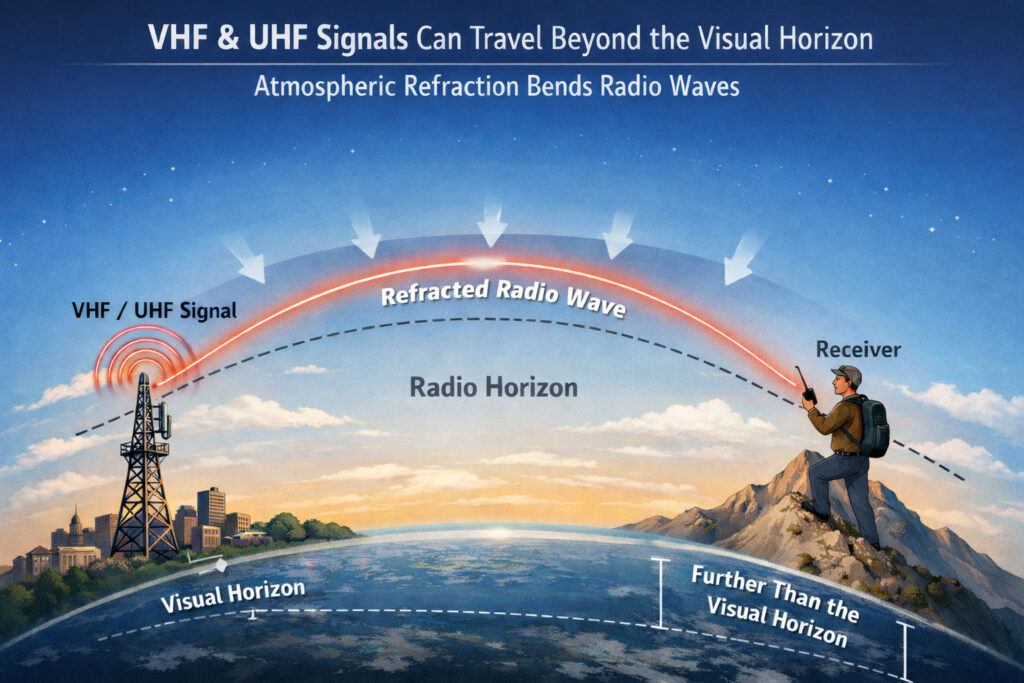
But VHF and UHF signals can travel further than the visual horizon, because the atmosphere refracts radio waves slightly.
Refraction means the atmosphere bends the signals, so they follow a slight curve around the Earth instead of a perfectly straight line.
But let’s say you want to talk across states, across the country, or even around the world. That’s where you need to use HF.
In the HF frequency range, you can bounce your signal off an upper layer of the atmosphere called the ionosphere and talk all around the world.
The ionosphere is a region of the atmosphere that can refract (or bend) HF radio waves back to Earth.
Long-distance ionospheric propagation is far more common on HF than on VHF and higher frequencies, because radio waves in the VHF and UHF frequency range won’t bounce off the ionosphere. Instead, they pass straight through. Which actually makes them good for satellite communications.
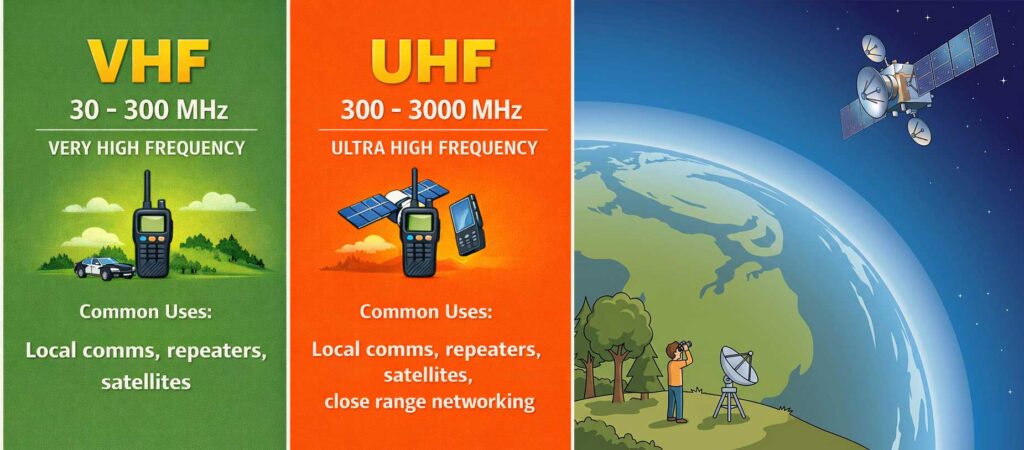
Simplex UHF signals are rarely heard beyond the radio horizon because UHF signals are usually not propagated by the ionosphere.
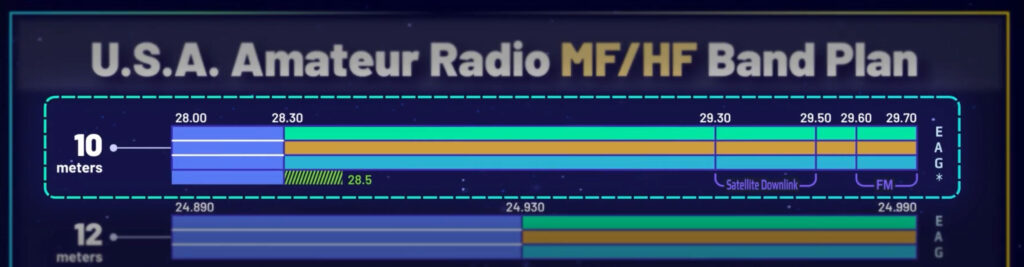
With your Technician license, you get a very small amount of access to HF frequencies on the 10-meter band. Many ham radio operators choose to upgrade to their General license in order to get more access to the HF bands for better long-range communications.
But there are lots of other types of propagation on VHF and UHF that can carry your signal further, too.
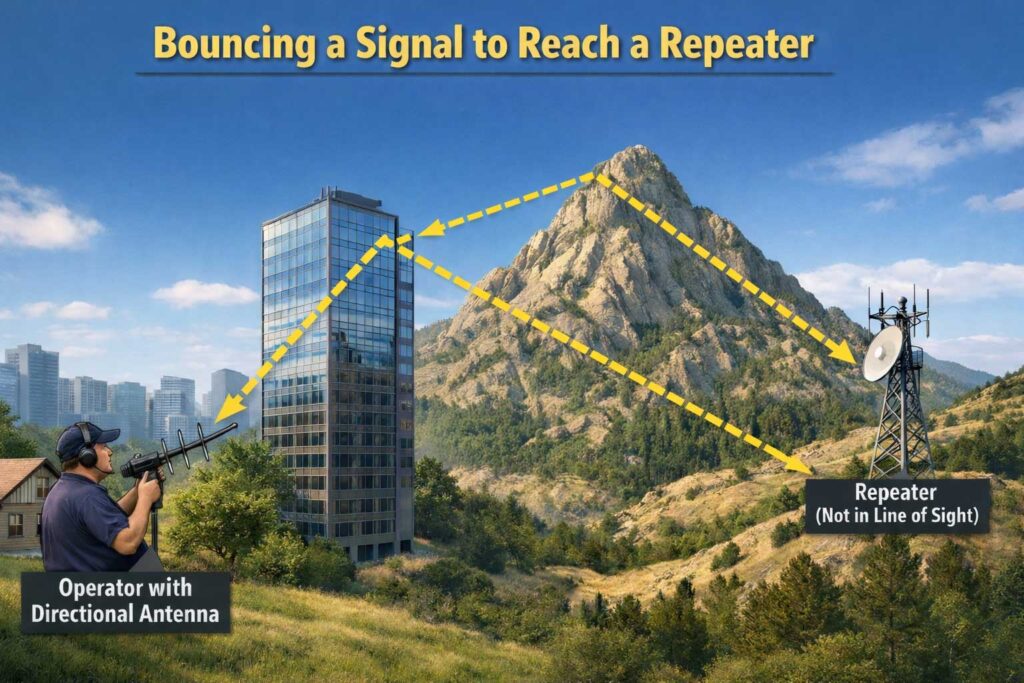
For both VHF and UHF, you can also utilize reflection – bouncing signals off of surfaces like buildings and other obstructions.
Say you have a directional antenna and you’re trying to reach a repeater that is not in your line-of-sight path. Using that antenna, you might bounce your signal off a building or mountain to try to find a path that reflects signals to the repeater.
There are lots of other types of propagation you can use to carry your signal that we’ll cover later.
The Basics of Radio Waves
Radio waves are all around us, invisible signals that carry information at the speed of light.
A radio wave is made up of two parts, electric and magnetic fields. Together, they make an electromagnetic wave.
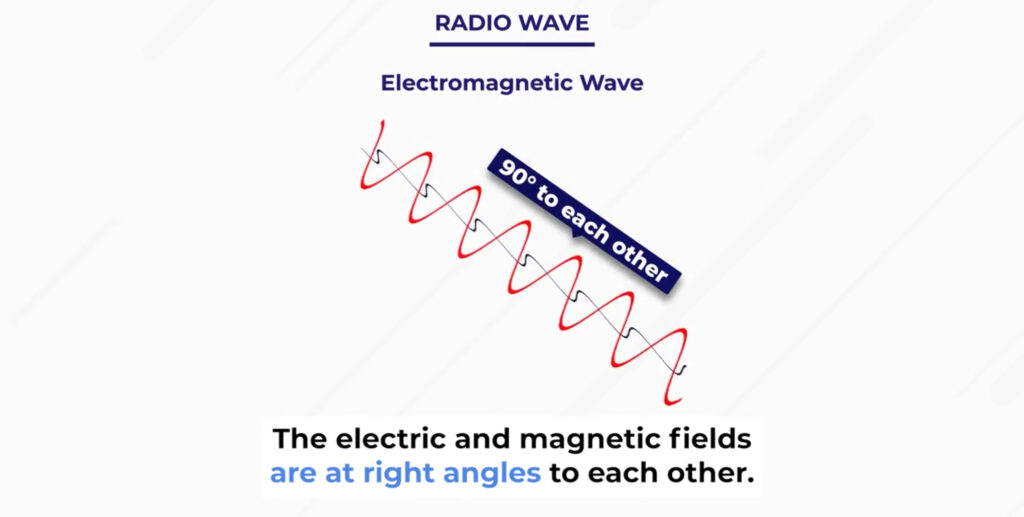
The electric and magnetic fields are at right angles to each other.
Polarization
Radio waves can vibrate in different directions – usually vertical, horizontal, or circular. This orientation is called “polarization.”
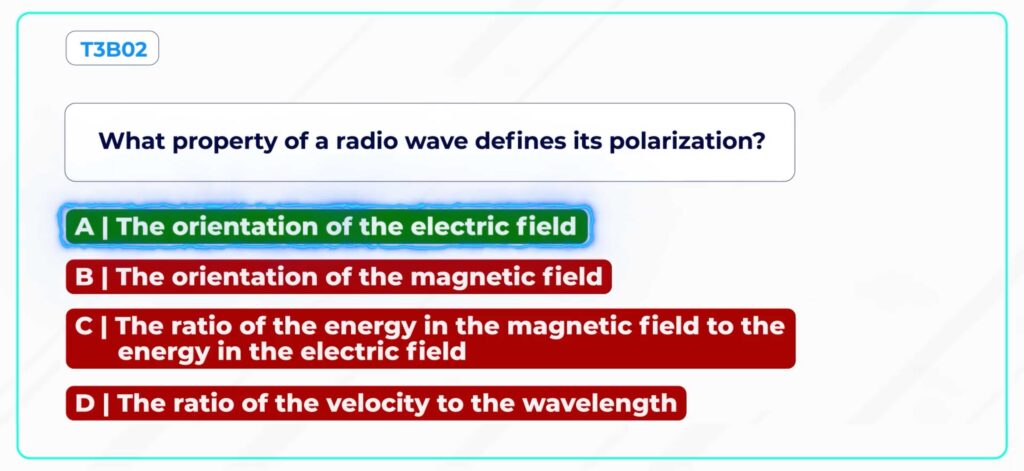
When describing the polarization of a radio wave, we look at the orientation of the electric field. Many students get stuck on this question.
- Remember, polarization does not involve a ratio, so you can rule out those answers right away
- So, between the orientation of the magnetic and electric fields, the electric field is the correct answer.
- (think “E” for electric and “E” for easier to remember!).
Polarization is helpful to know when setting up an antenna. For best results, match your antenna to the polarization of the signal you want to receive.
For example, when a radio wave is going up and down, it is vertically polarized. You’ll see that on repeaters, most of their antennas are straight up and down.
To get the best reception, you keep your handheld radio antenna in the same vertical orientation.
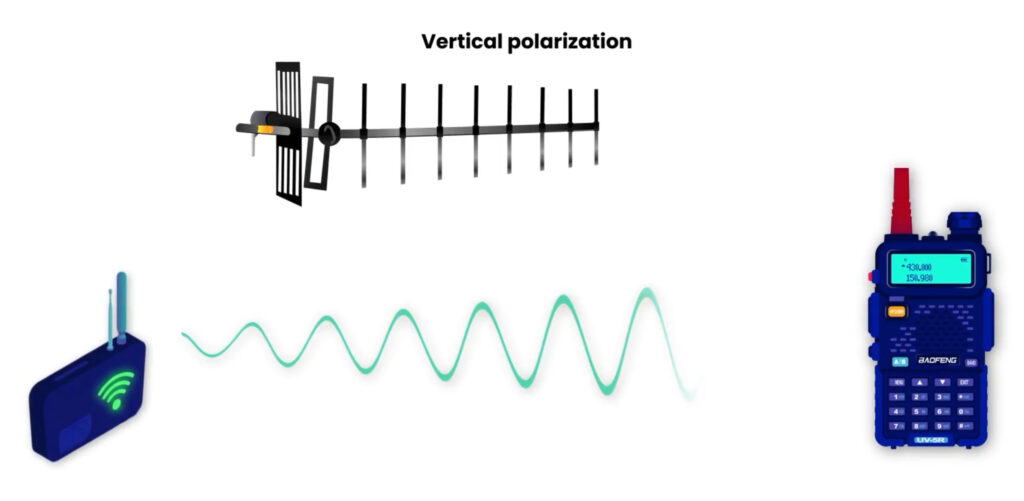
Some VHF signals are horizontally polarized, and their signal vibrates side to side. TV station signals are a good example, or long-distance CW and SSB contacts are usually horizontally polarized too.
When making long-distance CW and SSB contacts on the VHF and UHF bands, horizontal antenna polarization is optimal.
A signal like from a GPS satellite might be circularly polarized.
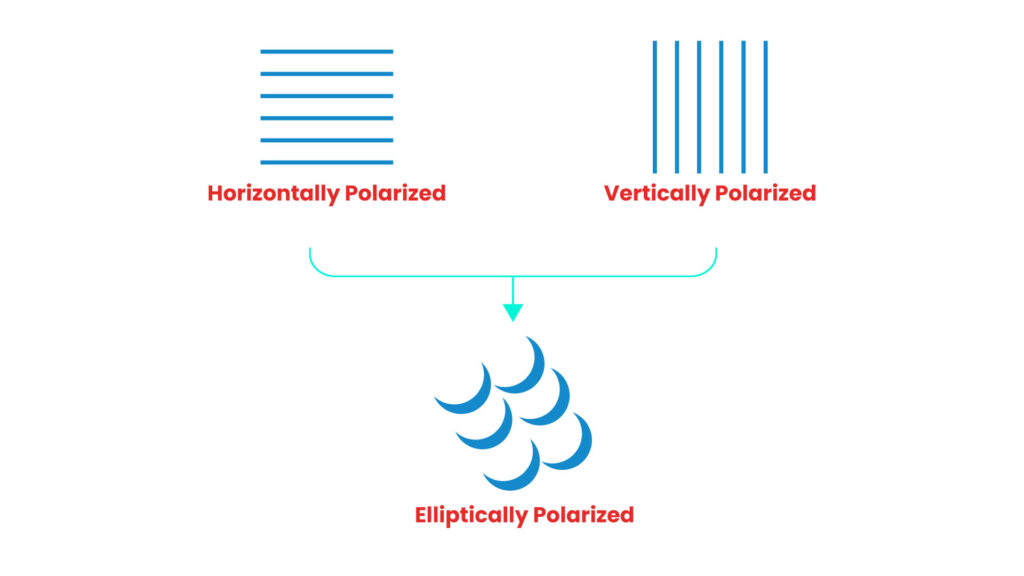
And sometimes the ionosphere stretches that circle into an oval, creating elliptical polarization. That’s OK because when ionospheric propagation makes a signal elliptically polarized, either vertically or horizontally polarized antennas may be used for transmission or reception.
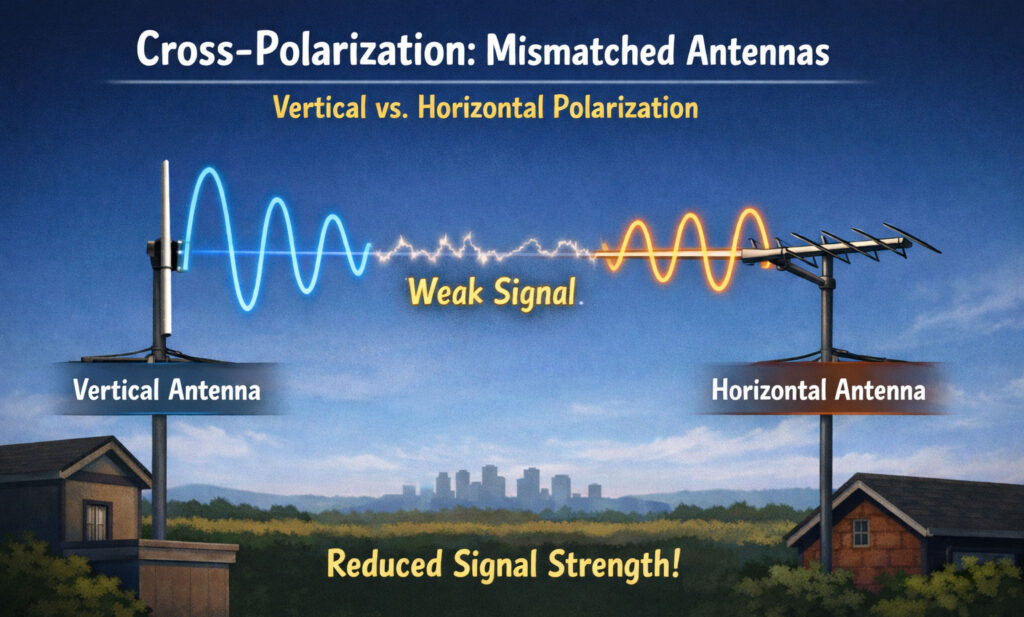
What happens when one antenna is vertically polarized, and the other one is horizontally polarized, and they communicate? We call this cross-polarization. The result for a line-of-sight VHF or UHF path is that received signal strength is reduced. You might still be able to make contact, but it’s not ideal.
And remember, polarization is all about optimizing your signal. In ham radio, you don’t always have to have your antenna at the perfect angle to send and receive messages.
Speed of radio waves
How fast does your radio wave travel through the air?
You might be surprised to learn that the velocity of a radio wave traveling through free space is the speed of light.
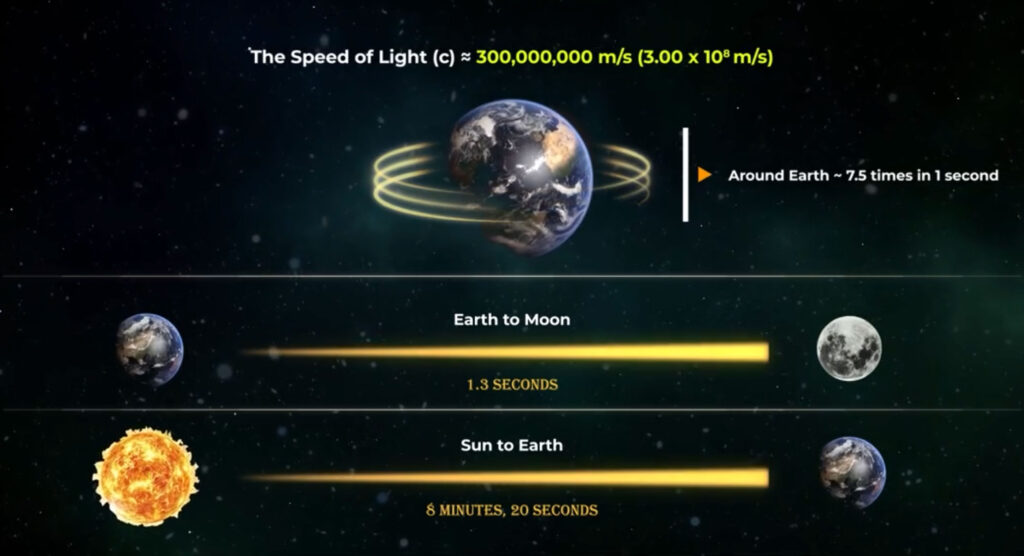
Amateur radio uses the metric system, so, memorize this number: the speed of light is 300,000,000 meters per second. An exam tip – skip any answers in miles per hour.
There are no differences based on the band you are using – all radio frequencies travel at the same velocity – the speed of light.
Wavelength and frequency
When we talk about radio waves, we usually refer to the wavelength and the frequency. The frequency is a measure of how fast the radio wave cycles. The wavelength is the distance between two peaks of the radio wave.
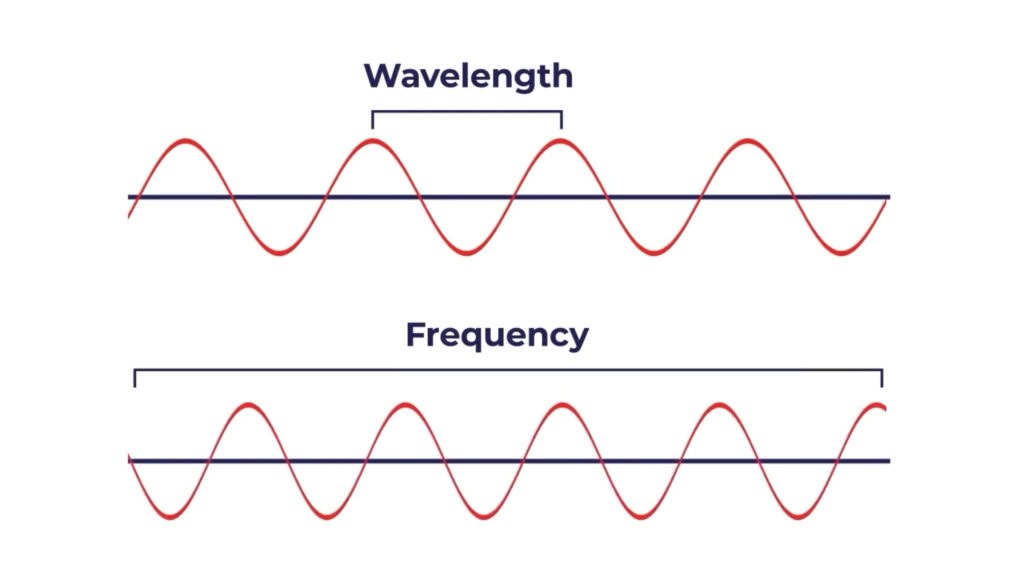
In addition to frequency, you can use the approximate wavelength in meters to identify amateur radio bands.
For example, the frequency of 28.4 MHz is in the 10-meter band. 10 meters is the approximate wavelength.
That’s why in ham radio, when we talk about bands, we are really referring to ranges of frequencies.
If you haven’t noticed the relationship between wavelength and frequency yet, wavelength gets shorter as frequency increases.
You can also convert frequency to wavelength using a simple formula. Wavelength in meters equals 300 divided by frequency in megahertz.
Let’s do the math using those frequencies we just discussed,
For example, 300 ÷ 28.4 MHz = 10.56 meters. Rounding this to 10 puts it in the 10-meter band.
You can use this simple formula to figure out which band a frequency is in.
Lesson recap
In this lesson, we explained how radio waves travel differently depending on the frequency range of HF, VHF and UHF. We learned that with VHF and UHF you can communicate slightly further than the radio horizon because of refraction, and on HF you can talk worldwide by bouncing signals off the ionosphere. We also discussed how polarization is determined by the electric field orientation and why it’s best to match your antenna polarization. Finally, we established that all radio waves travel at the speed of light (300,000,000 m/s) and that as frequency increases, the wavelength gets shorter.