Simplex
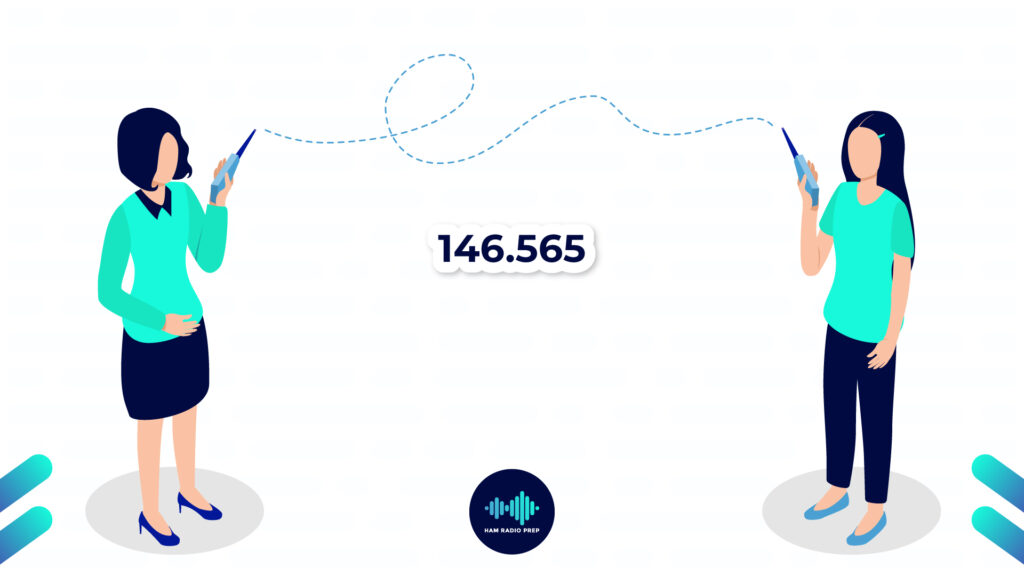
The most basic way to make contacts on ham radio is called Simplex. Just think of Simplex = simple – it’s direct radio-to-radio communications. Simplex is when an amateur station is transmitting and receiving on the same frequency – like walkie-talkies.
You can easily set up simplex communications with some friends, and it’s even easier than talking on a repeater. For example, Jim and I simply set our radios to the same exact frequency. Now we can communicate via simplex.
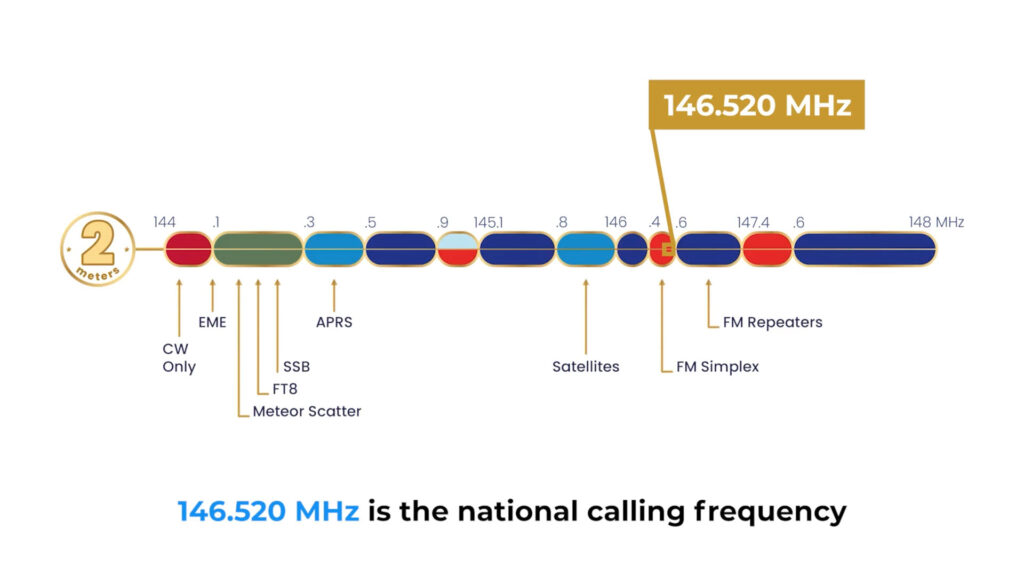
How do you know which frequencies are best to use for simplex communications? That is where a band plan can help. A band plan is a voluntary guideline for using different modes or activities within an amateur band.
The band plan also recommends national calling frequencies, which are common frequencies that ham radio operators monitor for simplex contacts.
146.520 MHz is the national calling frequency for FM simplex in the 2-meter band plan. If you ever see a bumper sticker that says 146.520, that’s what that means!
The great thing about using simplex is that it doesn’t require any repeaters or other infrastructure. One reason for having simplex frequencies in the VHF/UHF band plans is so stations within range of each other can communicate without tying up a repeater.
DMR and Digital Talkgroups
Probably your first contacts on ham radio will be FM analog, which is the most common, standard voice mode. But that is just the beginning – you can also use digital modes like Fusion, D-Star, and DMR that provide additional functionalities and advantages.
One of the most popular is DMR, which stands for Digital Mobile Radio. It converts your voice to digital data, which makes it very efficient.
DMR uses “talkgroups.” A talkgroup is an identifier used by DMR to organize radio traffic so that those who want to hear the group aren’t bothered by other radio traffic.
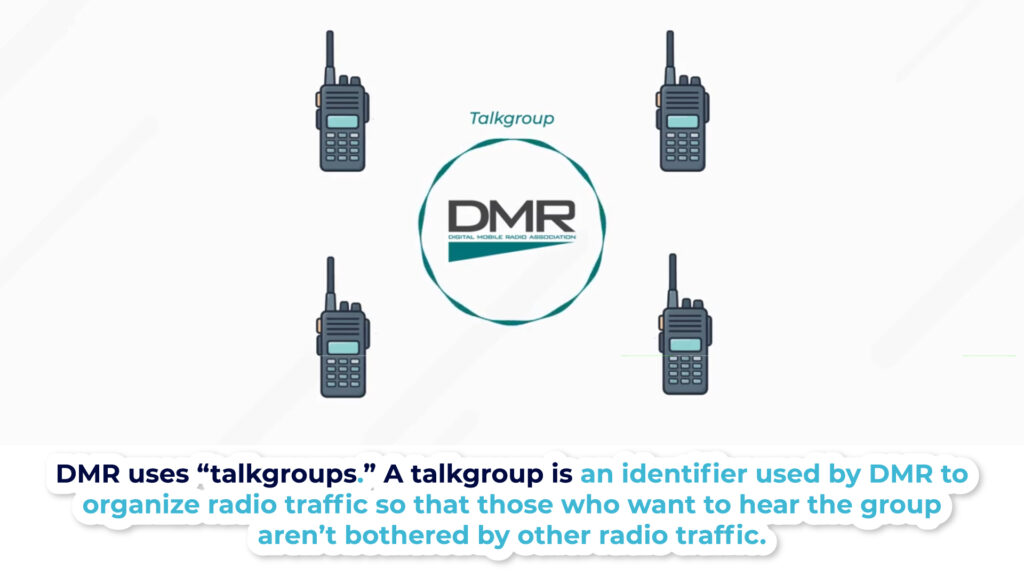
A talk group is like a chat group for ham radio operators. You’ll find local talkgroups just for your repeater, with names like “Local 8.” Or, find networked talkgroups organized by states, regions, and countries with names like “Worldwide 91.”
DMR radios are different from basic FM handhelds, and they require specific programming using computer software. To join a DMR talkgroup, you’ll need to program your radio with the group’s ID or code.
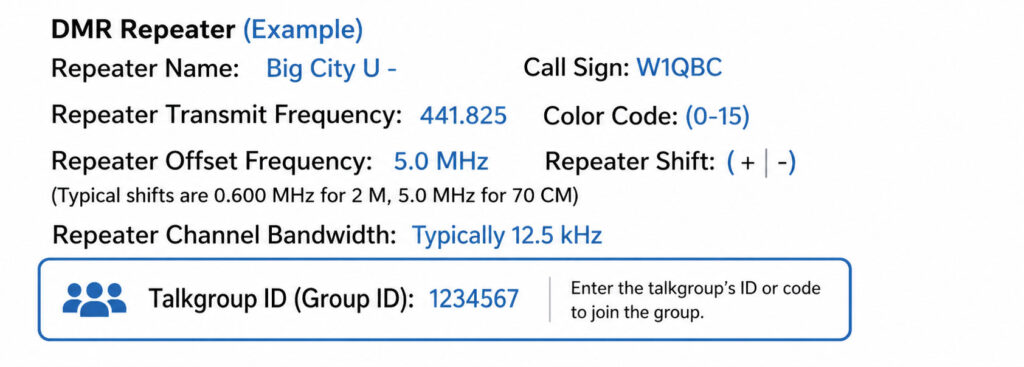
You’ll also need to know the DMR repeater’s “digital color code.” A digital color code is an access code which must be programmed into a DMR transmitter to access a specific repeater.
Once you have the talkgroup ID and Color Code, also add the frequency and offset, like you would for any repeater to join a DMR talkgroup. Here’s what DMR sounds like when you get it all put together:
RACES, ARES, and Emergencies
A primary mission of amateur radio is to have a trained group of people to operate in an emergency. Ham radio works completely off-grid when other forms of communication fail, and ham radio operators have assisted with communications in all kinds of natural disasters. They regularly volunteer for events like marathons and other public service events.
There are several major organizations that ham radio operators can join to assist in emergency communications.
One of them is RACES, the Radio Amateur Civil Emergency Service, which is the only emergency communication group mentioned specifically in the FCC rules. RACES is an FCC Part 97 amateur radio service for civil defense communications during national emergencies. Because RACES interfaces directly with government agencies like FEMA and state and local agencies, RACES requires certification by an emergency management agency before participating.
Logo of RACES, the Radio Amateur Civil Emergency Service, by Wikimedia
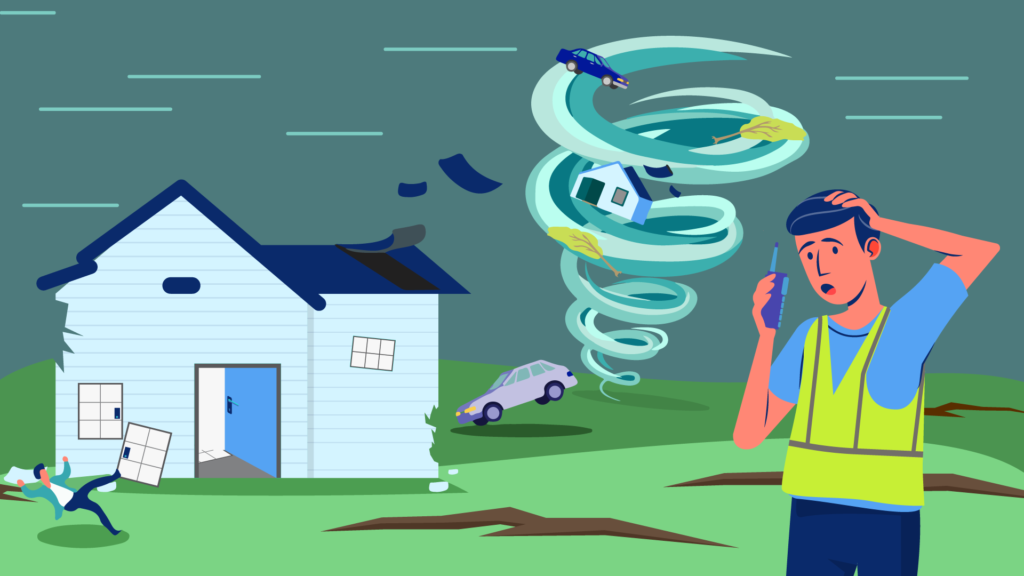
Even when you are working with a group handling an emergency, FCC rules always apply. There are no exceptions, even if you are working with groups like RACES or FEMA.
However, this is an exception where amateur station control operators are permitted to operate outside the frequency privileges of their license. This is only in situations involving the immediate safety of human life or protection of property.
Another major emergency organization is ARES, the Amateur Radio Emergency Service. It’s organized by the ARRL, a national ham radio organization. ARES is a group of licensed amateurs who have voluntarily registered their qualifications and equipment for communications duty in the public service.

Logo of ARES, the Amateur Radio Emergency Service, by Wikimedia
If you are interested in helping with emergency and public service communications, you may join RACES or ARES, or other groups like CERT, AuxCom, and REACT.
If emergency communications or “emcomm” is what sparked your interest in ham radio, check out our course called Emergency Communications 101 to get started.
Net Operations and Relaying Messages
Emcomm groups provide communications when an emergency happens and assist in public service communications, like parades or marathons, which is great practice.
Ham radio operators frequently use nets for emcomm purposes. A ham radio net is like a ham radio group chat with a specific purpose and protocol. A net can use a repeater or simplex, depending on the needs.
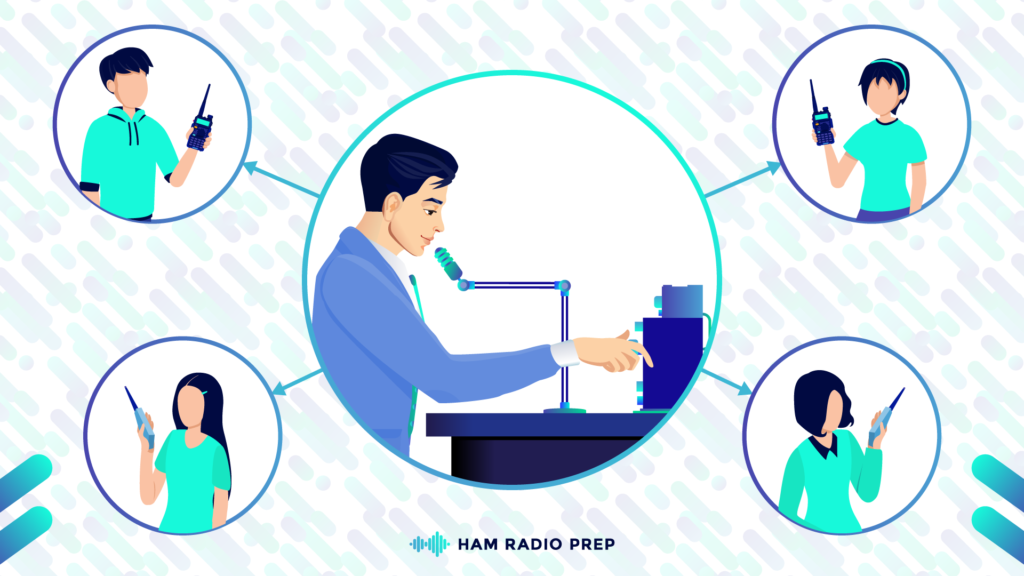
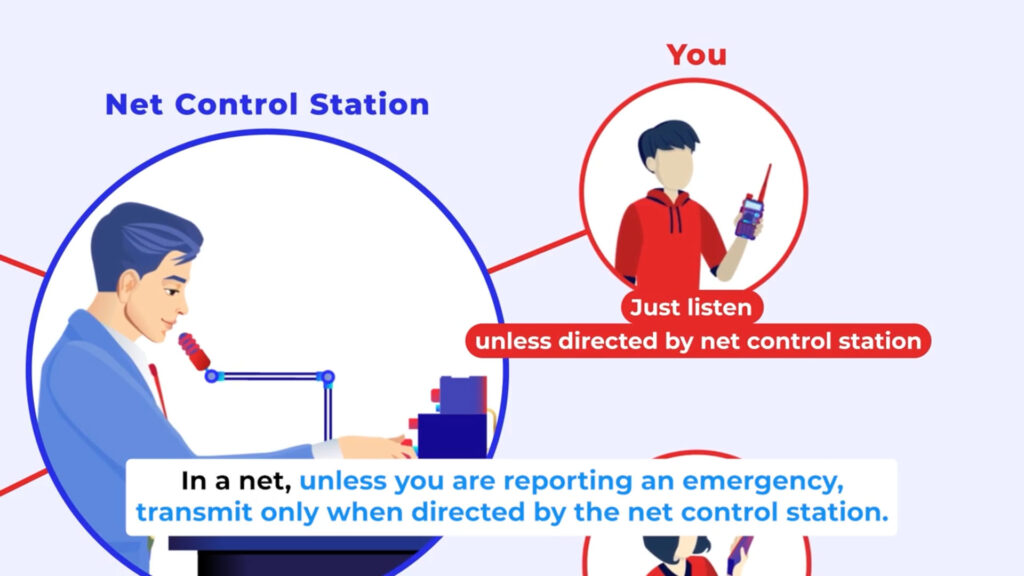
Most nets will have one point for coordinating communications, called a Net Control Station. Their duties are in their name: Net control will call the net to order and direct communications between stations checking in.
Many students get confused with the duties of the net control operator on the exam. While “all of the above” seems like a tempting answer regarding net control duties, remember that net control is NOT responsible for choosing the meeting time or checking everyone’s license – net control is focused on ordering and directing communications on the net.
Here’s another pro tip for the exam: “all of the above” is only the correct answer about a third of the time you see it in this course.
In a net, unless you are reporting an emergency, transmit only when directed by the net control station. Every net will have its own rules and guidelines.
When talking on a net, we usually refer to the communications as “traffic”. “Traffic” refers to formal messages exchanged by net stations.
An example of traffic during the road race might be to report when a runner needs assistance. The operator would send detailed information to the net, like this:
There are regularly scheduled ham radio nets happening every day around your local area on repeaters or even around the world that you can join.
Ham radio nets sometimes use radiograms to transmit information – it’s like a telegram but over radio, with a specific format to make sure information is passed accurately.
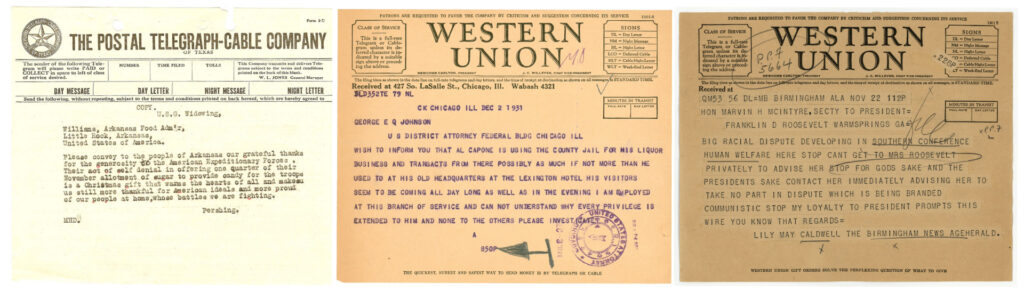
Radiogram Examples, by Wikimedia
In a “radiogram,” the beginning – or preamble – will contain information needed to track the message.
This header will also have a “check” that shows the number of words or word equivalents in the text portion of the message. This helps ensure that the entire message is received.
Another important way to make sure messages containing unusual words are received accurately is to spell the words using a standard phonetic alphabet.
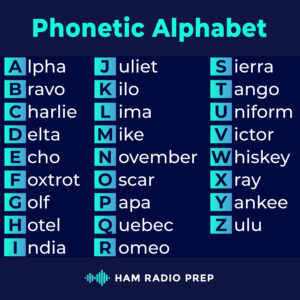
Phonetic Alphabet List, by Ham Radio Prep
Another great tool for emergency communications is Winlink , which is like an off-grid email service for ham radio operators that allows you to relay messages using email addresses.
Q Codes
To shorten messages, hams use a tool that goes back to the days of telegraphs – but is still used on voice and other modes today. Those are three-letter messages called Q signals or Q codes.
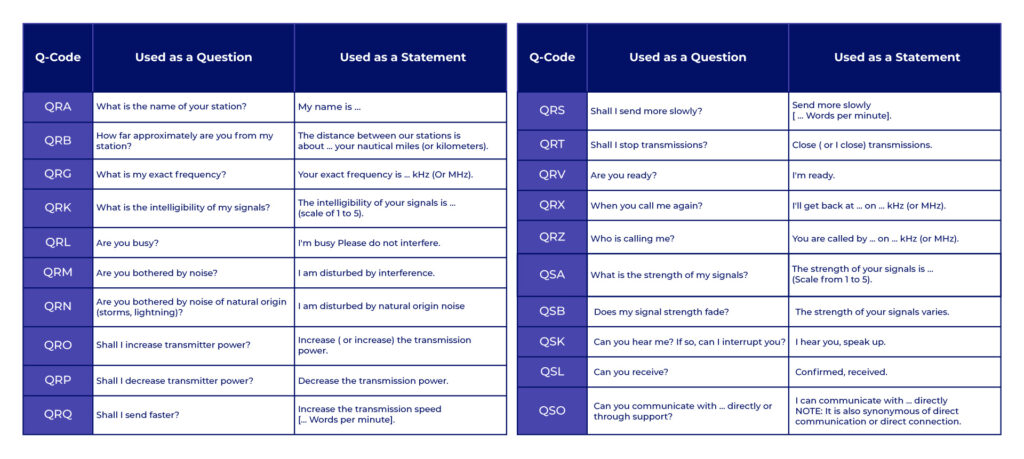
Q Codes List, by Ham Radio Prep
QSL probably is the most frequently used Q code – QSL means “message received”. It can be used as a statement like, QSL – “I received your message” or a question, like, QSL – “Did you receive my message?”
You’ll frequently hear ham radio operators say “QSL” on the air to confirm they received your message.
The Q signal QRM means you are receiving interference from other stations, aka manmade interference. Think of the M in QRM as manmade.
The Q signal QRN also means you are receiving interference, but that is for natural interference, like lightning, causing noise on frequencies. Think N for “natural.”
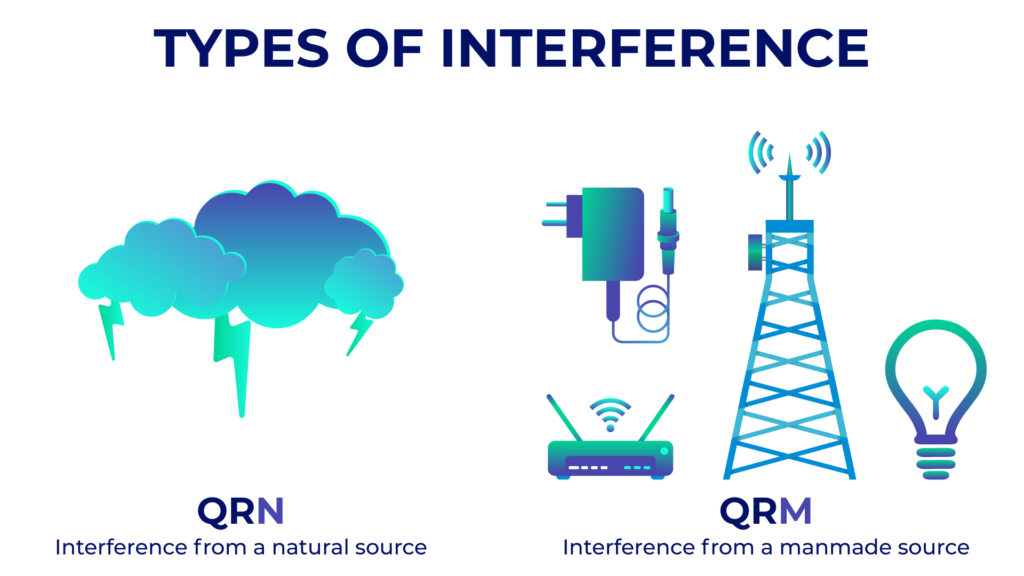
QRN and QRM, by Ham Radio Prep
One more super common Q signal is QSY. That’s for changing frequencies. You’ll hear “I’m going to QSY to 446.0” or “should we QSY to 2 meters?” as examples.
Notice that all the Q Codes start with Q. That’s because no country has callsigns with a Q, so they never get confused for call signs.
Lesson recap
In this lesson, you learned that simplex is an easy way to make ham radio contacts by transmitting and receiving on the same frequency, without needing a repeater. You learned that there are efficient digital modes like DMR, which use talkgroups. We discussed various emergency communications organizations like RACES, which is critical for national emergencies, and we talked about how FCC rules always apply, but you can operate outside your license privileges only in situations involving the immediate safety of human life or the protection of property.
Finally, we looked at how nets organize radio traffic, using tools like Q signals and the phonetic alphabet to ensure clear communication.