Let’s cover some rules about good operating practices and avoiding interference with other stations.
First, it’s important to define the control operator, who is the person in control of the ham radio station.
Part 97 is the part of the FCC rules that covers all of amateur radio. According to Part 97, a control operator is “An amateur operator designated by the licensee of a station to be responsible for transmissions and FCC rules compliance at that station.”
In other words, the person who holds the amateur radio license, the station licensee, designates the control operator, the person in control of the station.
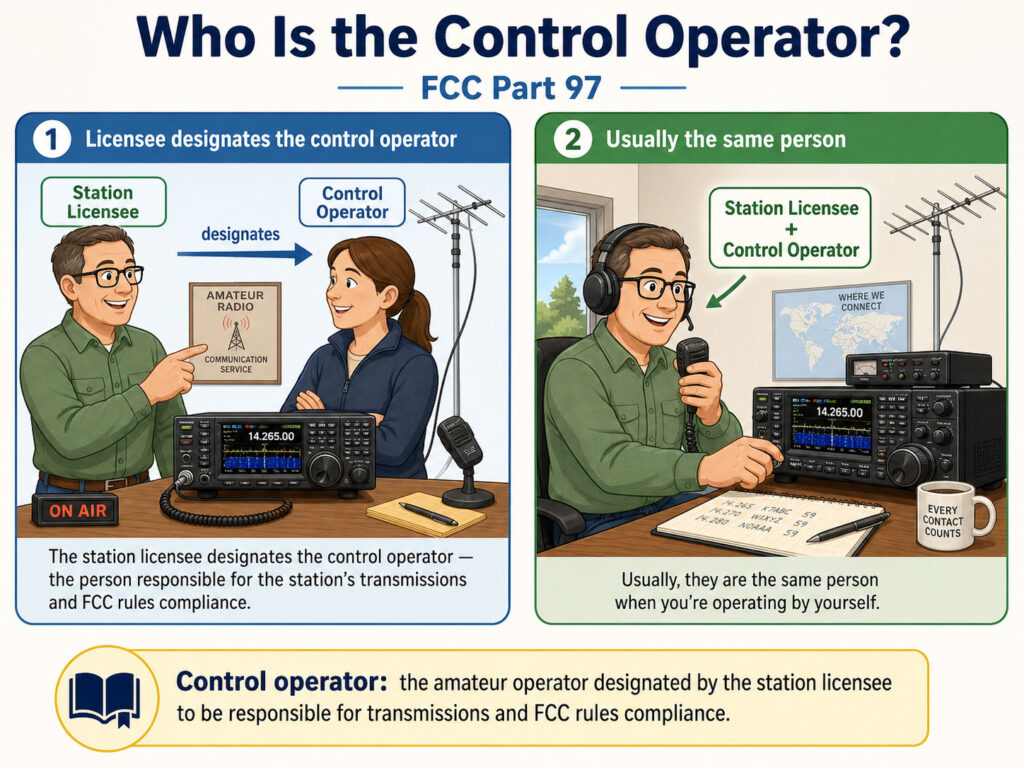
Usually, the control operator and the station licensee are the same person, like when you’re operating by yourself.
But what if you’re a Technician and a friend with an Amateur Extra license level comes to visit your house and check out your station?
You can designate them as the control operator, and the privileges of their license apply.
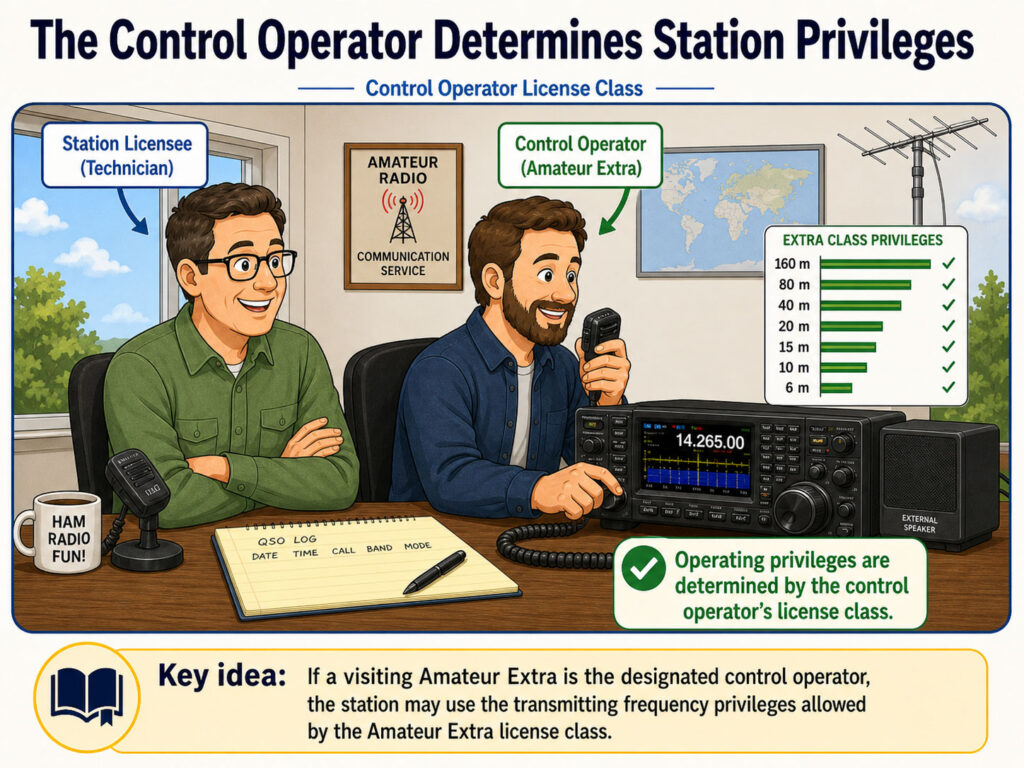
The transmitting frequency privileges of an amateur station are determined by the class of operator license held by the control operator.
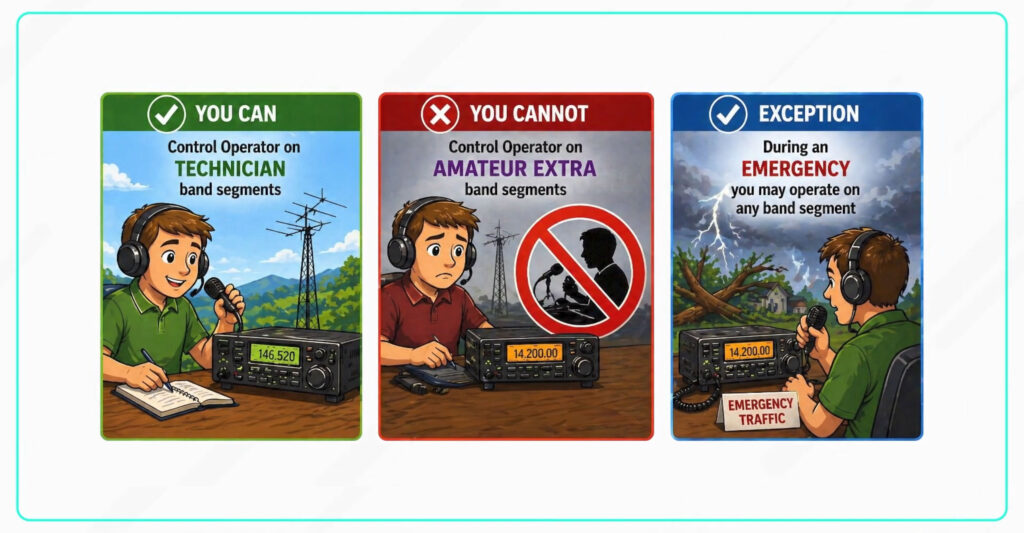
But as a Technician, at no time other than during an emergency can you be the control operator of a station operating in the Amateur Extra band segment.
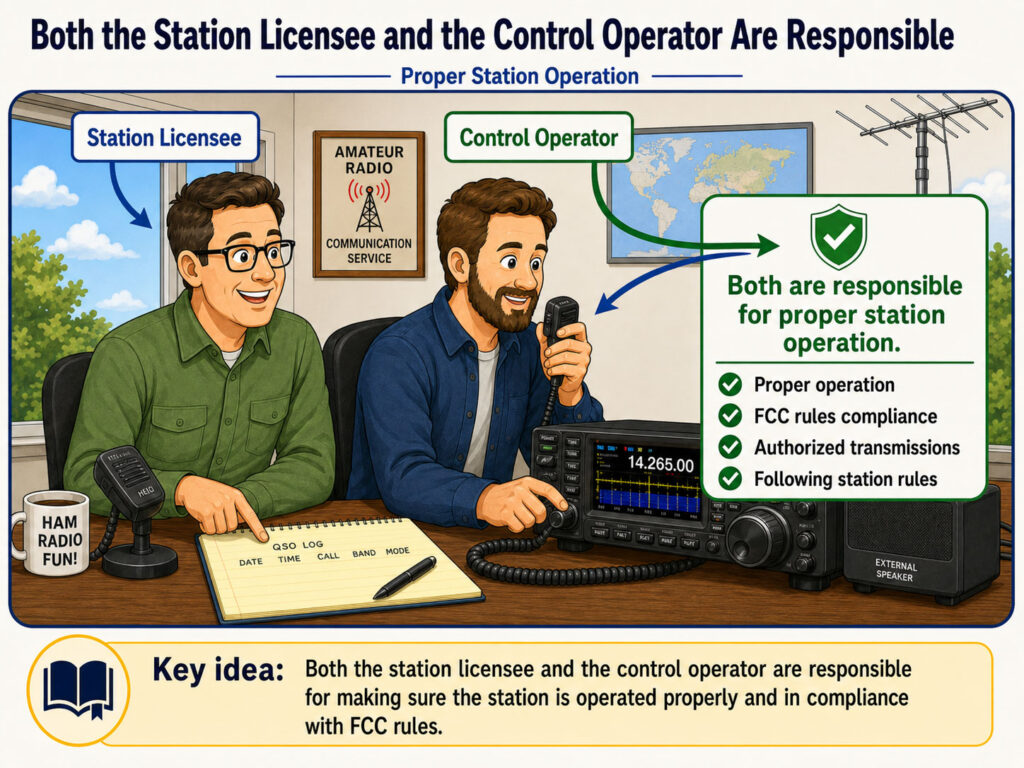
Let’s say you’re operating with a friend who is an extra, and you designate them as the control operator. So now, the station licensee is not the same as the control operator. Who is responsible for the proper operation of the station?
Well, both of you!
Both the control operator and the station licensee are responsible.
Even when using a repeater, you are responsible for your transmission. If the repeater retransmits something that violates FCC rules, it’s your fault as the control operator of the originating station, not the repeater’s fault.
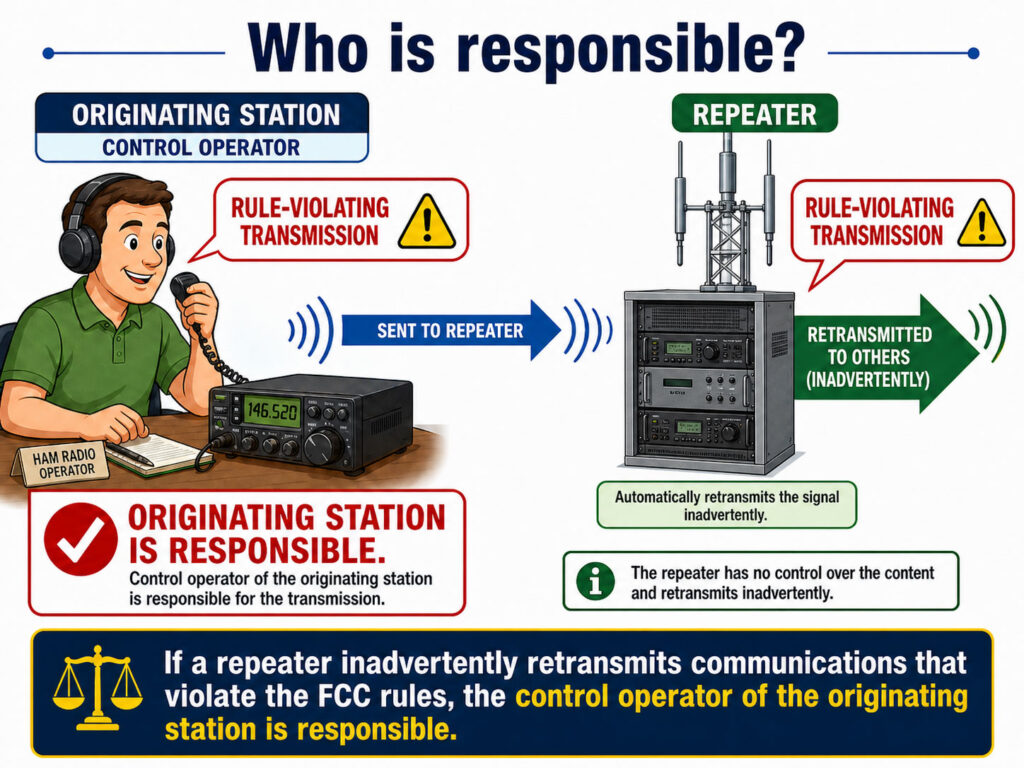
A station should never transmit without a control operator; somebody has to be in control of the station, even in the case of repeaters or auxiliary stations.
The term control point means the location at which the control operator function is performed. Usually, the control point is you right in front of your radio.
Automatic and Remote Control
There are two other types of station control: Remote control and automatic control.
Remote control is operating a station from a remote location, such as operating the station over the internet.
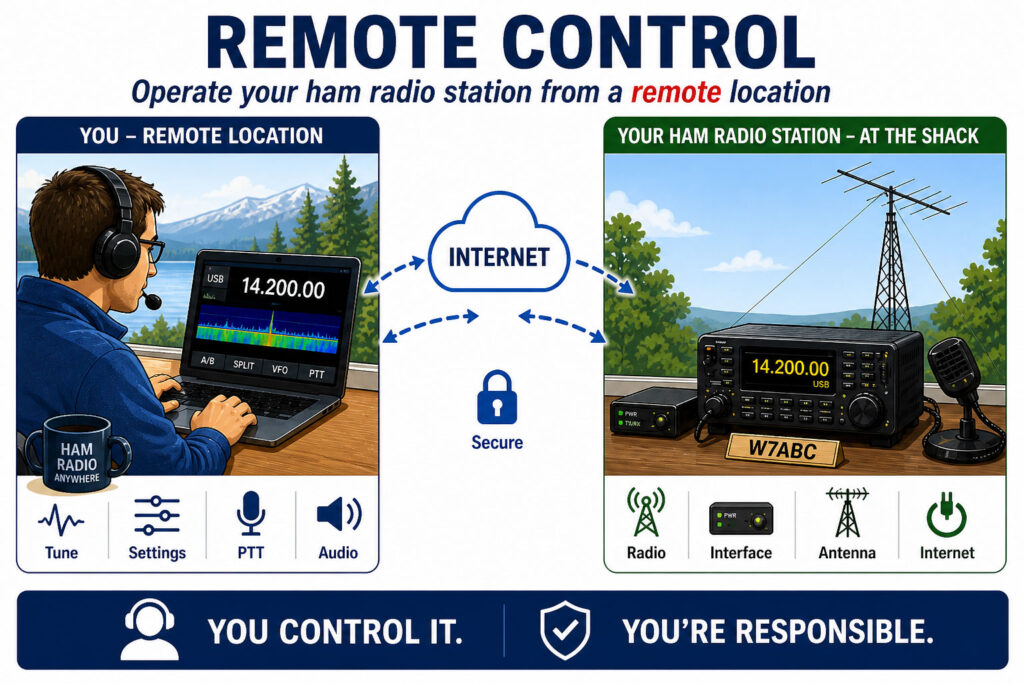
Do not get confused and think that a remote control in ham radio is like operating a model aircraft, boat, or car. The ham radio term for controlling a model craft is called telecommand. Remote control is about operating a station from a remote location.
Newer model radios like those made by Icom and Flex Radio are specially designed for remote operations. That allows hams like you to operate super-powerful stations with giant towers and antennas remotely by logging in to them over the internet.
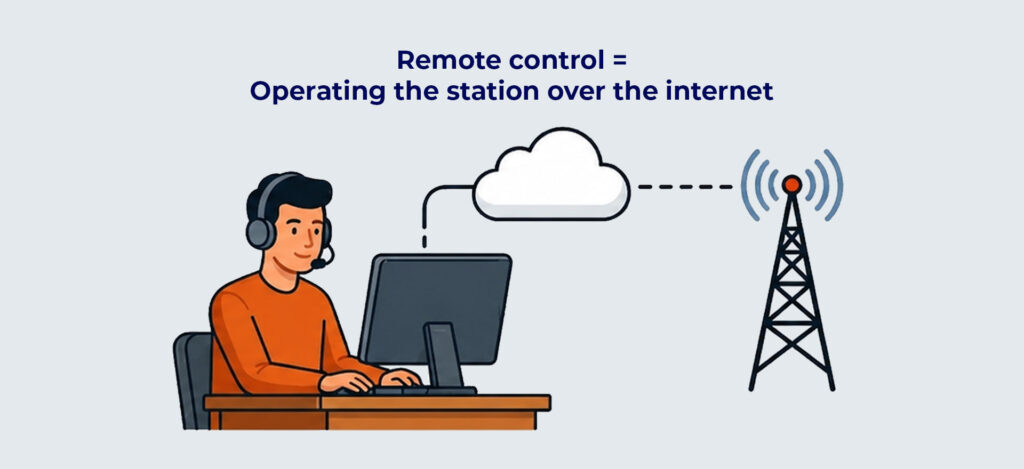
Any station may be remotely controlled in amateur radio, not just repeaters, automatically controlled stations, or digital stations.
Automatic control is when a station operates automatically. An example of automatic control is repeater operation, because a repeater automatically receives and retransmits signals.
A beacon is an automatically controlled station as well. A beacon automatically transmits signals with information like status, weather, or band conditions at regular intervals, usually in Morse code.
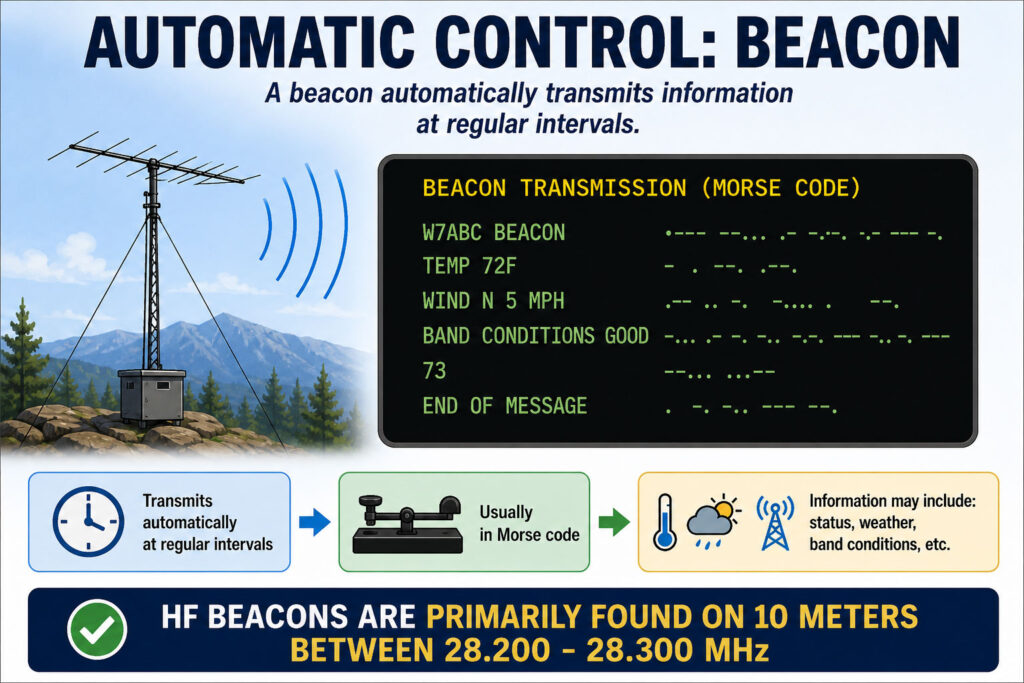
There are automatically controlled propagation beacons on ten meters, between 28.200 MHz and 28.300 MHz that transmit signals to help measure propagation, or how well signals are currently bouncing around the Earth.
Emergency Communications / RACES
Emergency communications and public service are an important part of ham radio, and amateur radio operators have been critical in natural disasters like hurricanes, wildfires, and earthquakes.
There are various emergency communications groups you can join, and some of them work in tandem with the government, like RACES, the Radio Amateur Civil Emergency Service.
Logo of RACES, the Radio Amateur Civil Emergency Service, by Wikimedia
RACES is strictly to support government agencies. To be a control operator RACES requires certification of current enrollment by a civil defense organization.
Third Party Communications
One of the things you may do in RACES is send messages for other people, such as passing important emergency information.
That is called third-party communications. Specifically, it is a message from a control operator to another amateur station control operator on behalf of another person.
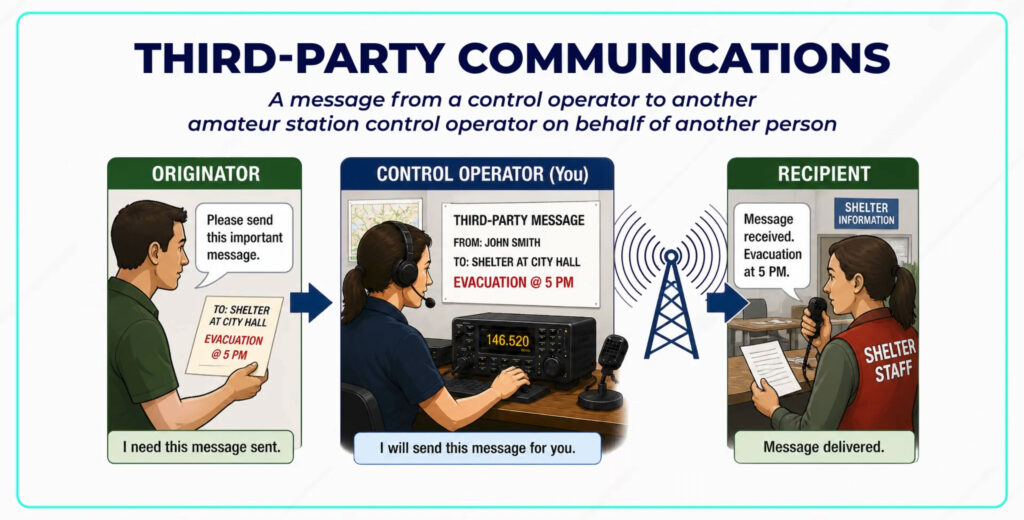
In other words, it’s using your amateur radio privileges to pass important information on behalf of another person.
Talking to Foreign Countries
Let’s talk about the rules when communicating with other countries.
According to the FCC, when making international communications, you are allowed to make communications incidental to the purposes of the Amateur Radio Service and remarks of a personal character.
This basically means you’re allowed to have normal conversations, but you’re not allowed to conduct business or broadcast.
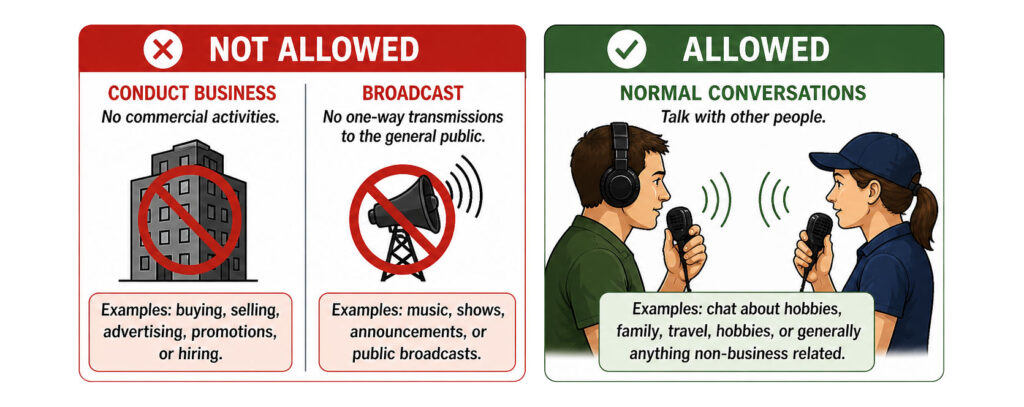
There are special restrictions when a non-licensed person speaks to a foreign amateur radio station under your control, such as if your non-licensed friend wants to talk to other countries on your station while it’s under your control.
The foreign station must be in a country with which the U.S. has a third-party agreement. You can find the list of the 40 or so approved countries on the FCC website.
Are there any countries that you aren’t allowed to contact at all? You aren’t allowed to make contact with any country whose administration has notified the International Telecommunication Union (ITU) that it objects to such communications.
The ITU is the international governing body for amateur radio around the world. The ITU works globally with the FCC in the US and the agencies of other countries. The good news is, that as of the making of this video, there are no banned countries. So, enjoy making new friends with people in countries all around the world.
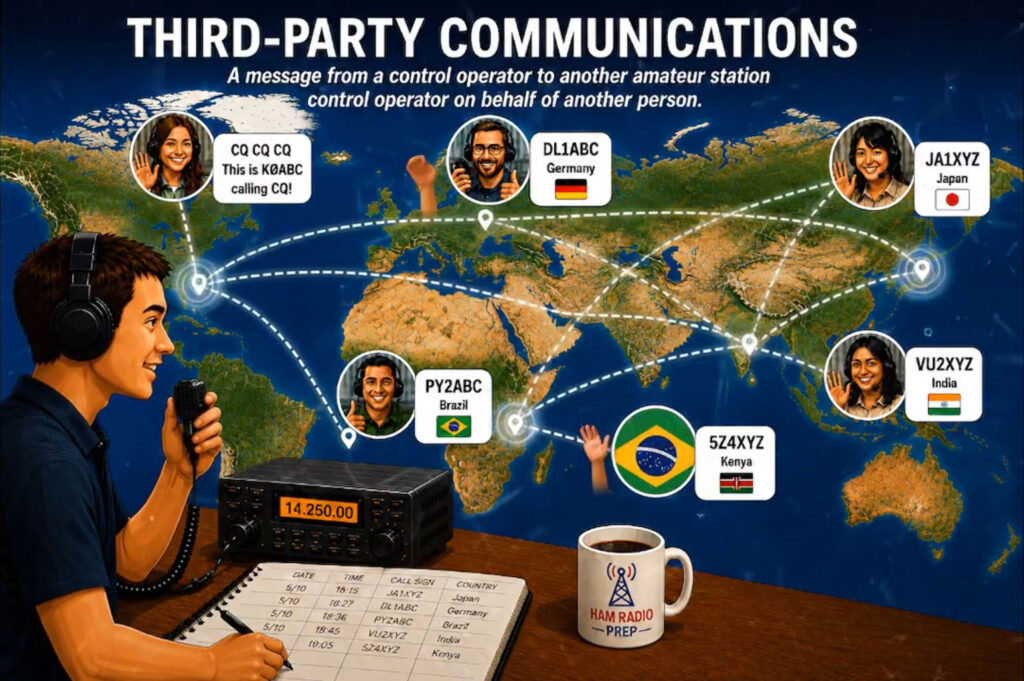
Some ham radio operators even track how many countries they’ve contacted and try to get them all in their log.
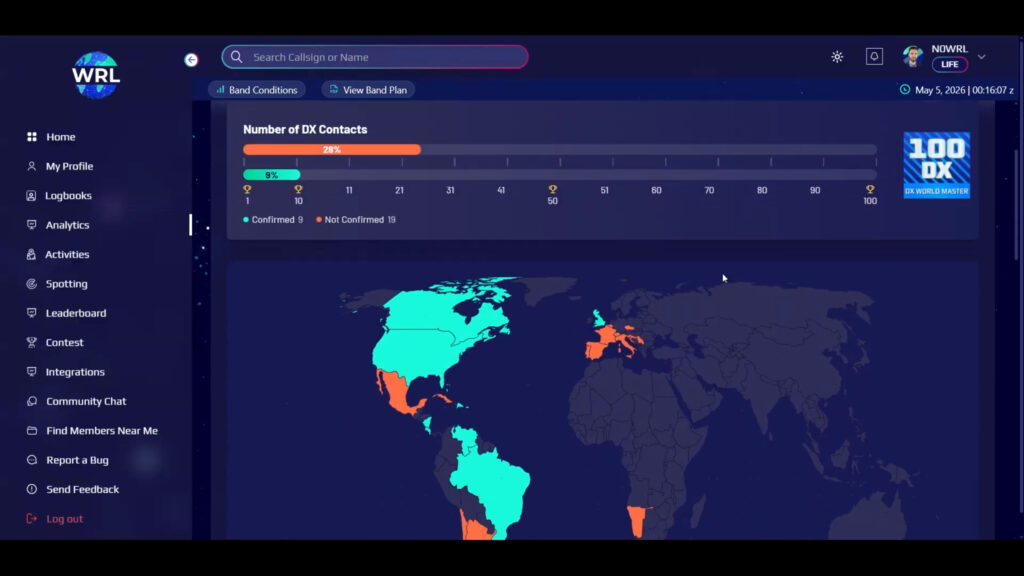
Use a digital logbook for free: https://worldradioleague.com/
Operating In International Waters & Airspace
Are you allowed to operate from a ship in international waters? When aboard a ship, called vessels and crafts, you need to ask the captain first. They are called “the master” of the vessel. So yes! You may operate from a US-documented vessel with the master’s permission.
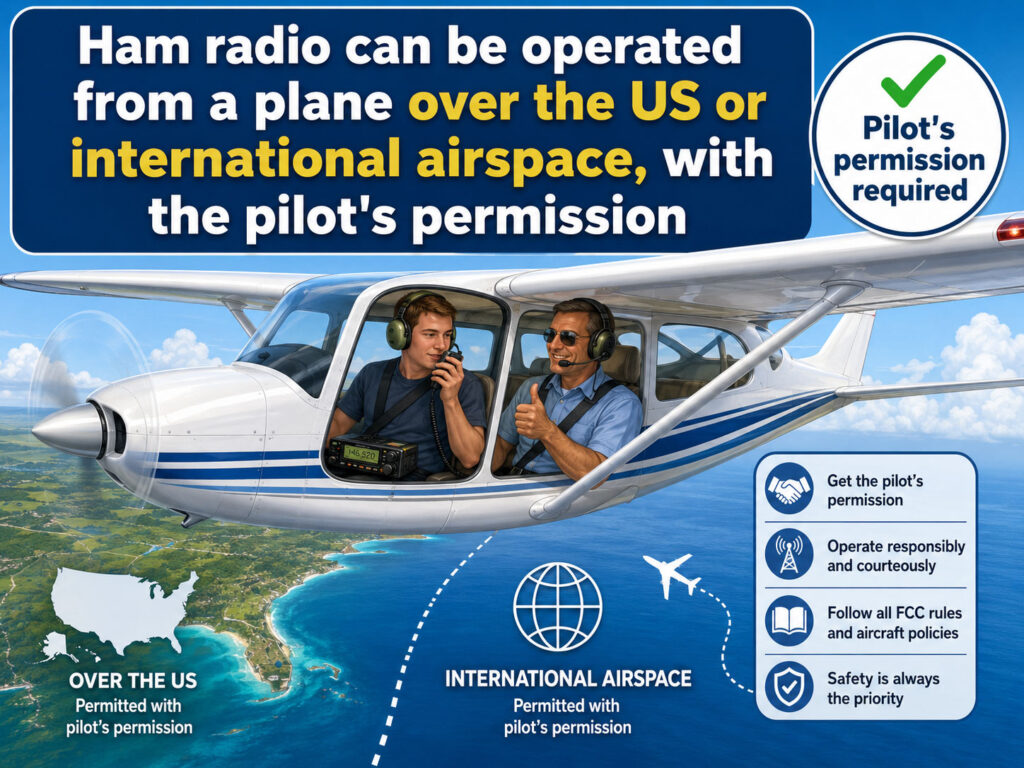
Similarly, ham radio can be operated from a plane over the US or international airspace, with the pilot’s permission. But commercial airliners generally don’t allow this, so this would have to be a special case with precautions, where you have the pilot’s permission on a private plane.
Space & Satellite Operations
You can even expand your ham radio operations to space. In the amateur radio world, the FCC defines a space station as an amateur station located more than 50 km above Earth’s surface.
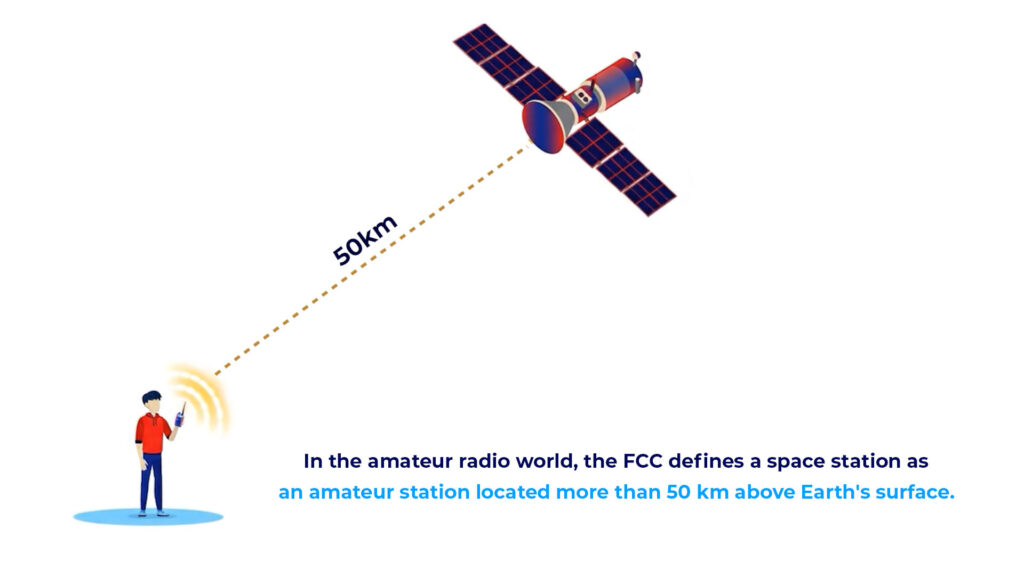
There are dozens of amateur radio satellites and even amateur radio on the International Space Station and some SpaceX missions.
Satellite and space contacts usually happen on the VHF and UHF bands, so any amateur with a Technician class or higher license can use the ISS repeaters. While it’s super rare, sometimes the astronauts pick up the microphone and make some contacts too!
A simple rule here. Any amateur allowed to transmit on the satellite uplink frequency can use the satellite. Even if it repeats your signal down to a band you don’t normally have privileges for.
Space is one of the most exciting frontiers in amateur radio. After you get your Technician license, check out our Satellite & Space Operations course to get started.
Lesson Recap
Let’s recap. Every ham radio station has a control operator, who is designated by the station licensee. Ham radio stations can be operated remotely over the internet – and remote operations does NOT mean operating model craft to the FCC. You can talk to foreign countries all around the world with amateur radio, as long as you follow the rules against doing business or broadcasting. You can also operate in international waters and on planes with special permission by the captain, and you can communicate with dozens of satellites and the International Space Station with just a Technician license.