Antennas
The antenna is one of the most important parts of any ham radio station. In this lesson, you’ll learn how antennas work, including antenna length and resonant frequency, antenna tuning, antenna gain, and more.
Antenna Length & Resonance
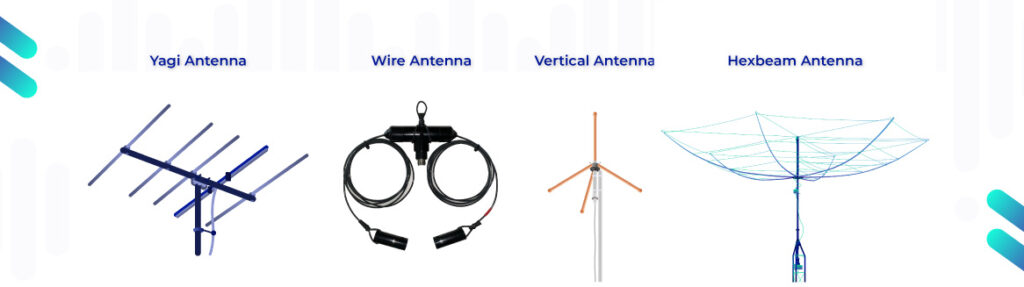
There are many different types of antennas in ham radio: wire antennas, vertical antennas, directional antennas like Yagis and hexbeams, and, of course, the small antennas that come standard with handheld radios.
Even though they look very different, they all follow the same basic principle.
An antenna is a conductive piece of metal or wire that resonates at a particular frequency, creating a radio wave.

It’s just like how a guitar string vibrates to create sound, except antennas are creating electromagnetic waves.
The length of the antenna is very important because the length determines the resonant frequency, just like how changing the length of a guitar string changes the frequency of the sound.
Antennas are typically designed to be a fraction of the wavelength – most commonly a half-wave or quarter-wave – so they resonate efficiently at the desired frequency.
For example, let’s say you want to make an antenna that is resonant for the 2-meters band. A full wavelength is 2 meters, or about 78 inches.
To make a quarter-wave antenna, 78 inches divided by 4 is about 19 inches.
A 19-inch-long vertical antenna is often used on 2 meters because it is a resonant quarter-wave antenna.
Changing the Length of An Antenna
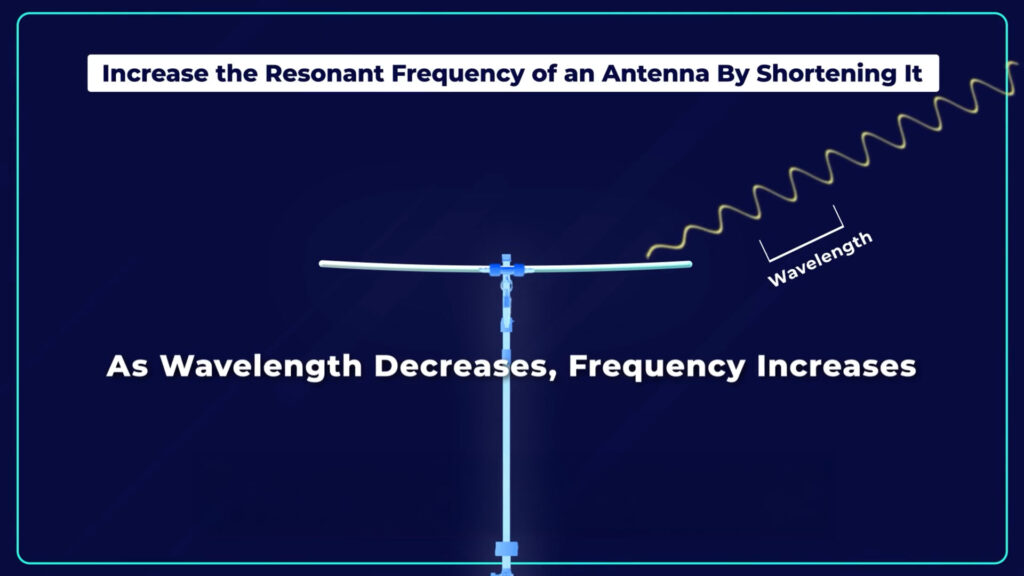
Remember that wavelength and frequency are inversely related – as wavelength decreases, the frequency increases.
A simple rule of thumb is that longer antennas are used for lower frequencies, and shorter antennas are used for higher frequencies.
Let’s use a half-wavelength dipole antenna as an example, which is just two pieces of wire with the feedline in the middle.
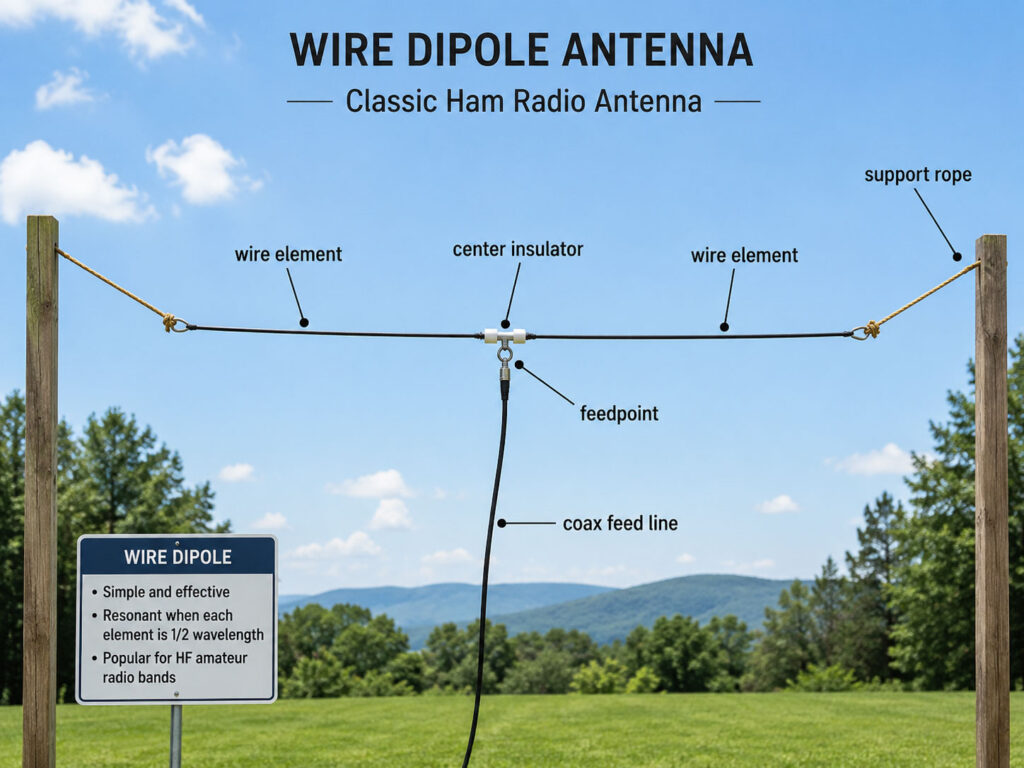
- To make a half-wavelength dipole for the 10-meters HF band, around 28 MHz, take the wavelength of 10 meters and divide it in half – the total length will be about 5 meters.
- That is much longer than an antenna for the 2-meters band on VHF, which is around 146 MHz. A half-wavelength dipole for 2 meters would be around 1 meter
You can also tune the exact resonant frequency of an antenna by making it longer or shorter.
- As an antenna gets longer, the resonant frequency decreases
- As an antenna gets shorter, the resonant frequency increases
You can increase the resonant frequency of a dipole antenna by shortening it to decrease the wavelength.
To calculate the exact length of a dipole antenna based on your operating frequency, you can use the formula Length = 468 / frequency in MHz.
Antenna Tuning
In a perfect world, our antenna would always be the exact length to resonate on the frequency we want to use.
In reality, there is no such thing as a perfect antenna, and we often accept tradeoffs, like using multi-band antennas that resonate on various bands, although not perfectly.
This is where measuring SWR and tuning your antenna becomes important.
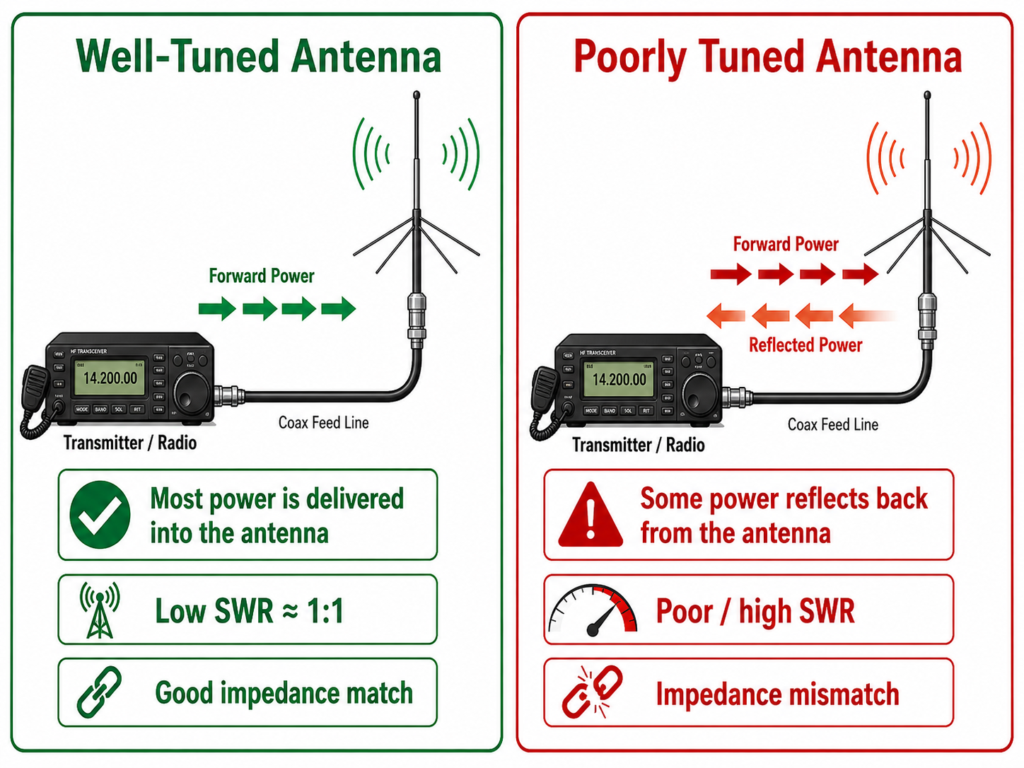
SWR, or Standing Wave Ratio, is a measure of how well a load is matched to the transmission line, and it is strongly affected by how well your antenna resonates at the desired frequency.
When your antenna is well-tuned, most of the power is delivered into the antenna, resulting in a low SWR of close to 1:1.
When your antenna is not well tuned to the operating frequency, some power will reflect back from the antenna, leading to an impedance mismatch and poor SWR.
For some antennas, like wire antennas, you may be able to shorten or lengthen the antenna to make it resonate, but in many cases, that might not be possible.
That’s where an antenna tuner comes in.
An antenna tuner matches the antenna system impedance to the transceiver’s output impedance, allowing you to operate your radio properly even if the antenna is not perfectly resonant.
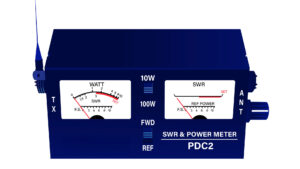
Many radios have built-in tuners, or they can be purchased separately.
Loading Coils
Sometimes you don’t have space for a full-size antenna.
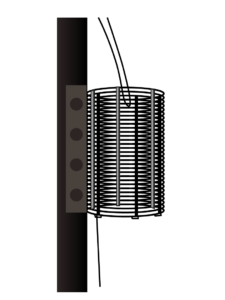
In these cases, you can make the antenna electrically longer by inserting inductors into the radiating elements. This is called antenna loading.
A type of antenna loading is electrically lengthening by inserting inductors in radiating elements.
You’ll often see loading coils on mobile antennas on vehicles, but they can be used on any antenna. These allow a physically short antenna to operate as if it were longer.
Antenna Gain
Another major factor in your antenna performance is the antenna gain.
Antenna gain is the increase in signal strength in a specified direction compared to a reference antenna.
Antennas don’t add extra power – only an amplifier can do that. They can, however, focus the signal in a specific direction.
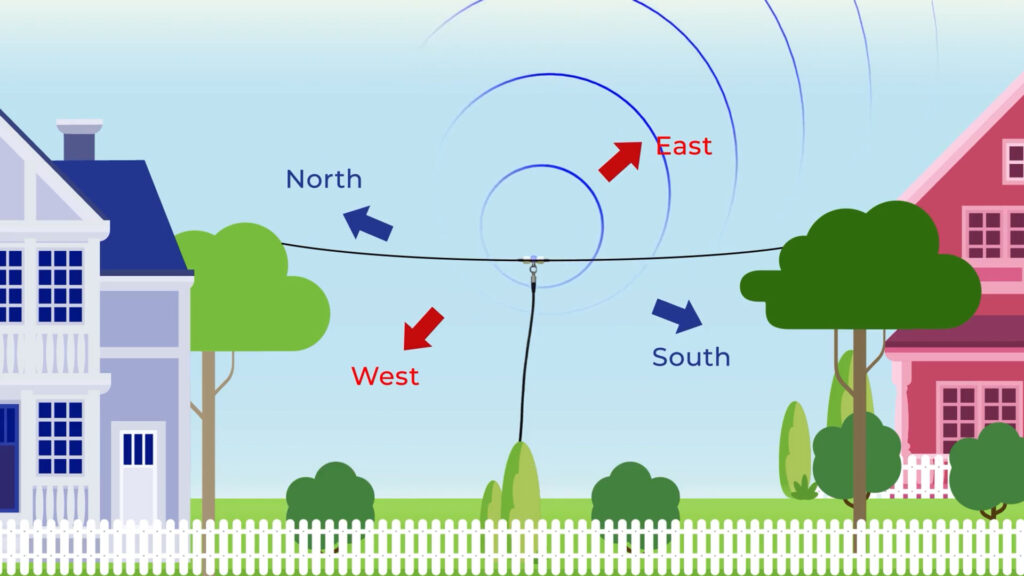
Let’s look at a half-wave dipole antenna as an example. A half-wave dipole radiates the strongest signal broadside to the antenna. For example, if the dipole antenna is running North to South, your strongest signals will go east and west.
Let’s say you really want to focus your signal in one direction – like if I’m in the southern United States, and I want to make contact with Europe. For that, I can use a beam antenna, an antenna that concentrates signals in one direction, and point the antenna toward Europe.
A Yagi antenna is the most popular type of beam antenna, and it offers more gain than other antenna types, such as ⅝ wave verticals, isotropic antennas, or J pole antennas.
If you’ve ever seen a rooftop TV antenna that looks like a fishbone, you’ve seen a Yagi antenna.
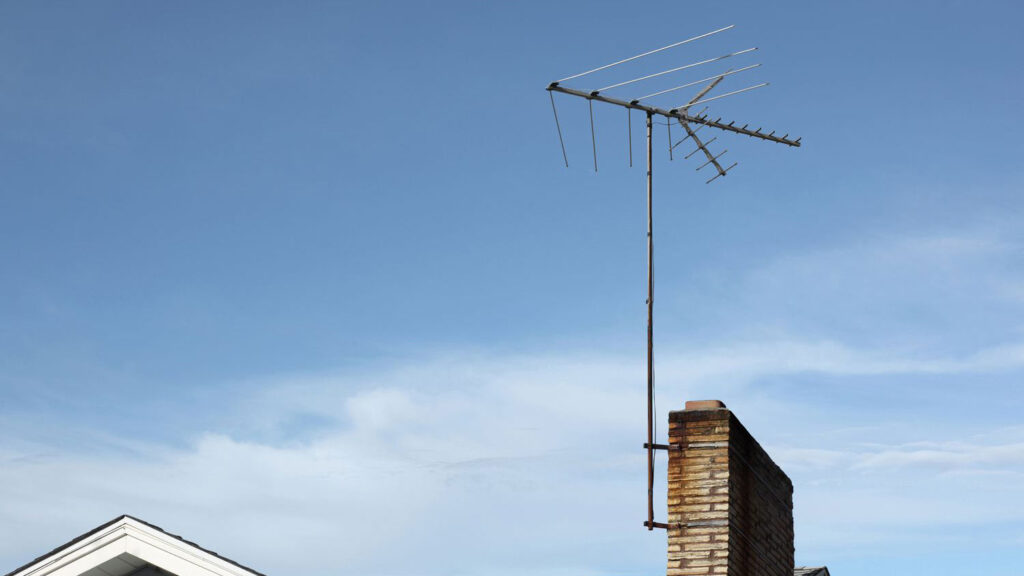
A yagi works by adding multiple antenna elements in parallel, which focuses the signal in one direction.
Yagi antennas are commonly used on ham radio towers for contesting and high-performance operation, using rotors to rotate the antenna to the desired direction.
Yagi antennas are also used to make contact with satellites, to direct your signal towards the satellite as it moves through the sky.
And you can even use a Yagi antenna to direct your handheld radio towards a nearby local repeater or to target another operator near you.
Handheld Antennas
Now let’s take a look at the short flexible antennas that come with most handhelds, which we often call “rubber duck” antennas.
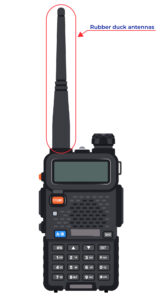
These small antennas are included from the factory because they are cheap, convenient, and portable, but they are shorter than a full quarter-wave antenna.
A disadvantage of a handheld radio transceiver’s short, flexible antenna compared to a full-sized quarter-wave antenna is that it has low efficiency, although it may work just fine for short distances.
One of the easiest upgrades for your handheld is replacing the stock “rubber duck” antenna with a longer aftermarket antenna that will improve your range dramatically. And yes, you can even connect your handheld to other types of antennas.
Vehicle Antennas
Let’s discuss antennas for use in your vehicle.
Using a handheld ham radio inside your vehicle may not be ideal because the signal strength is reduced due to the shielding effect of the vehicle. You may still be able to make contacts, but the signal strength and range are reduced.
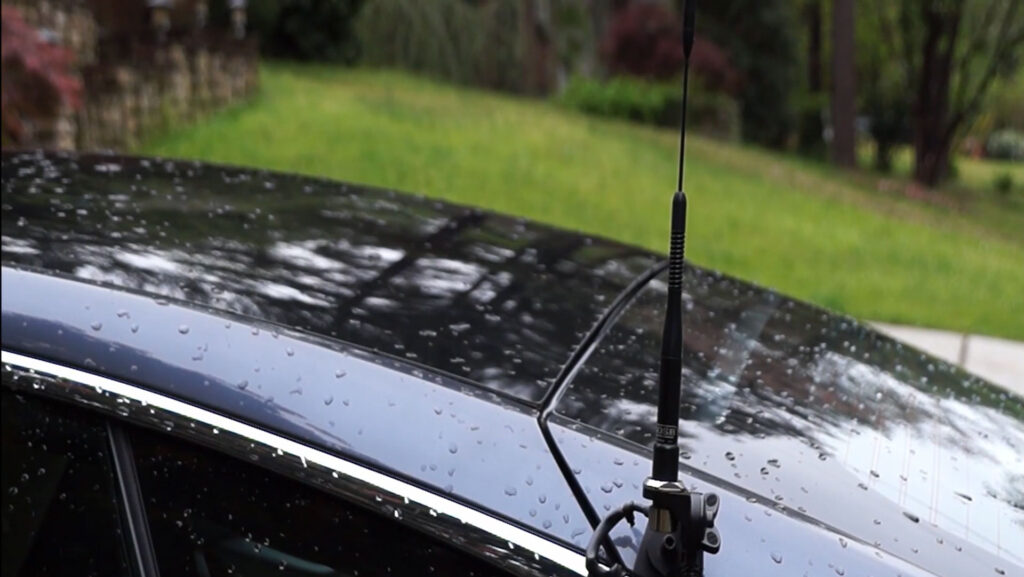
You can get better performance by mounting an antenna outside of your vehicle. A dual-band 2m and 70cm whip antenna is the most common choice for VHF and UHF. A whip antenna is a flexible, single-element antenna usually made of a thin metal rod.
Instead of a quarter-wave, mobile antennas for VHF and UHF are made for a 5/8 wavelength, because a 5/8 wavelength antenna has more gain as compared to a quarter-wave antenna.
Antenna Polarization
Throughout this lesson, you saw some antennas that are vertical, and some that are horizontal, and everything in between. The orientation of the antenna changes the polarization.
As an antenna radiates, it generates an electric field and a magnetic field.
The polarization of the antenna is described by the orientation of the electric field.
Wire dipoles and yagis on top of towers are frequently horizontally polarized, while vertical antennas are vertically polarized.
Antennas communicate best when both antennas have the same polarization.
Lesson Recap
Let’s recap.
- In this lesson, you learned that the length of an antenna determines the resonant frequency. A 19-inch-long antenna is a resonant quarter-wave for 2 meters.
- You learned that because wavelength and frequency are inverses, you can increase the resonant frequency of an antenna by shortening it
- We discussed how SWR is a measure of how well a load is matched to the transmission line, and that you can use an antenna tuner to match the antenna system impedance to the transceiver output impedance
- You learned that when you don’t have space for a full-size antenna, you can make an antenna electrically longer by inserting inductors called loading coils
- You learned that dipole antennas have the strongest signal broadside to the antenna, and that beam antennas like Yagis concentrate your signal in one direction
- We talked about the stock “rubber duck” antennas that come standard with handhelds, but are not as efficient as a full-sized quarter-wave antenna
- You learned that handhelds have reduced signal strength in vehicles because of shielding, and that a 5/8 wavelength antenna provides more gain than a quarter wave for VHF/UHF mobile
- And a final reminder – the polarization of an antenna is described by the orientation of the electric field