Do you know the difference between volts, kilovolts, or megavolts? Get ready to find out!
In this lesson, you’ll learn about units of measurement and the decibel scale.
Units of Measurement
Introduction to Prefixes
Every electrical measurement has a base unit, like volts, amperes, or ohms.
But what happens when you have a lot of volts, let’s say, 1,000 volts. It gets hard to manage all those extra zeros. That’s where a prefix comes in.
In this case, kilo is the prefix for one thousand, so one kilovolt is equal to one thousand volts. Using a prefix simplifies the number when it is too big or too small.
Here is a chart of the most common prefixes, which come from the metric system.
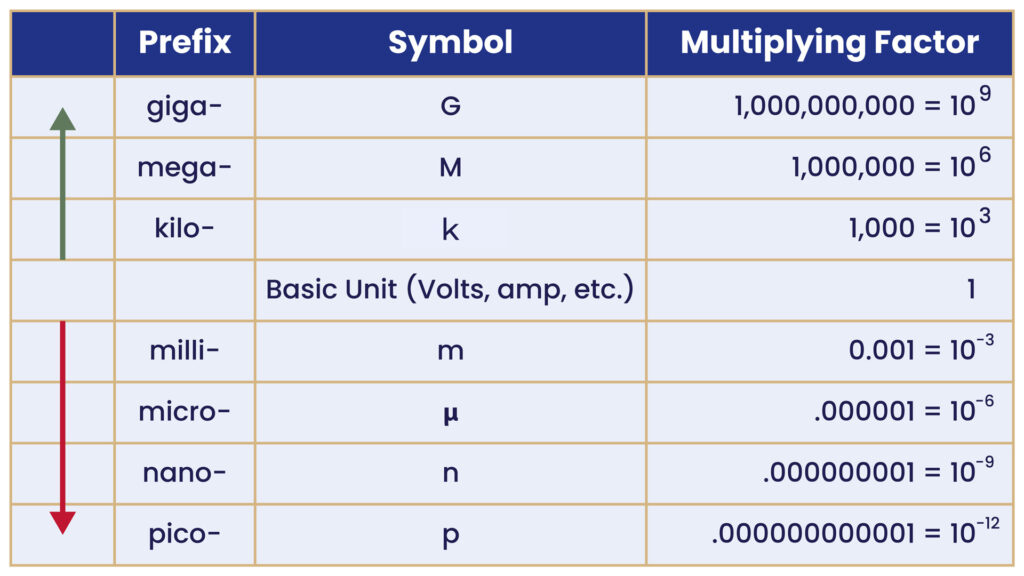
The base unit is the row in the middle.
As you go up the chart, the prefixes represent a larger number. Kilo- for one thousand, mega- for one million, and giga for one billion.
As you go down the chart, the numbers get smaller. Milli for one one thousandth, which means divided by one thousand, micro for one one-millionth, and pico for one trillionth. That’s a very small number.
As an example, one microvolt is one one-millionth of a volt, a very, very small fraction of a volt, used in applications like high-precision circuits and detectors.
Prefixes are usually written as abbreviations. For example, kHz (with a lower-case k) is the abbreviation for kilohertz. MHz (with an upper case M) is the abbreviation for megahertz. Notice that the abbreviation for kilohertz (kHz) uses a lowercase k, but the abbreviation for M is uppercase. This is because M is considered a “large” multiplier, and it prevents confusion with milli, which is a small m. All abbreviations kilo- and smaller use a lowercase letter.
Converting Units to a Prefix
For the exam, you need to learn how to convert units from one prefix to another.
Going back to our chart, notice that every row on the chart represents either multiplying or dividing by 1,000.
To convert from one prefix to another and move up or down the chart, we essentially need to “slide” the decimal point by 3 places for every row, which is the same as multiplying or dividing by 1,000.
The most important thing to remember is the direction you are moving the decimal point.
Moving Up to a Larger Prefix – Move the Decimal to the Left
When you move up the chart to a larger prefix, the number itself gets smaller, because the prefix is larger.
You move the decimal point to the left.
Let’s convert 500 milliwatts to watts as an example. We only need to move one row up, which means we need to move the decimal point 3 places to the left.
Write down 500 milliwatts on your paper, with the decimal point at the end. Then count 3 spaces to the left, and place your new decimal point.
Our answer is 0.5 watts.
You can check your work here with some common sense – does it make sense that 500 milliwatts add together to 0.5 watts? 1,000 milliwatts makes 1 watt, so yes, 500 milliwatts makes 0.5 watts.
Let’s try another one.
Let’s convert 3,000 milliamperes to amperes. To move up one row in the chart, move the decimal point 3 places to the left.
3,000 milliamperes equals 3 amperes.
For example, let’s convert 1,500,000 hertz to kilohertz. Hertz is the base unit in the middle of the chart. To move up to kilo-, we need to move the decimal point three places to the left.
1,500,000 hertz is equal to 1500 kHz.
Now let’s convert 28400 kHz to MHz. To move up one row on the chart from kilo- to mega-, we need to move the decimal point 3 places to the left.
28400 kHz equals 28.400 MHz.
The same exact technique works to convert megahertz to gigahertz. Let’s say we want to convert 2425 MHz to GHz.
Since we just need to move one row up the chart, we should move the decimal point by 3 places to the left.
2425 MHz equals 2.425 GHz.
Now let’s try a tricky one. Let’s convert 1,000,000 picofarads to microfarads. Pico is smaller than micro, by a factor of 10 to the 6. To move up two places on the chart to microfarads, we need to move the decimal point 6 places to the left.
1,000,000 picofarads equals 1 microfarad.
Moving Down to a Smaller Prefix – Move Decimal to the Right
When going from a large prefix to a smaller one, like going from amps to milliamps, the number itself gets larger. You move the decimal point to the right.
For example, to convert 1.5 amperes to milliamperes, move the decimal point 3 places to the right.
Write out your base unit on a piece of paper and add some zeros to the end. Then, count 3 decimal places to the right and add your new decimal to get your answer:
1.5 amperes equals 1500 milliamperes.
Check your work here by asking if your answer makes sense. Since milliamperes are smaller than amperes, it makes sense that 1500 milliamperes is the same as 1.5 amperes.
Here’s a tricky one – let’s convert 3.525 MHz to kHz. Neither megahertz nor kilohertz is a base unit. But, looking at our chart, we are only moving the value by one row down, which means we need to move 3 decimal places to the right.
3.525 MHz equals 3525 kHz. It’s very helpful in ham radio to be able to convert between megahertz and kilohertz, so those are the most common units we use for frequency.
Final Tips on Unit Conversion – Check Your Work with Common Sense
Here are some final tips to help you with the unit conversion questions on the exam.
- Remember that all of the common prefixes move are based on the metric system and multiply or divide by 1,000, so you are always moving 3 decimal places to the left or right to move up or down one row on the chart.
- Use your common sense to check your work and remember which way to move the decimal point.
- If you have a current of 1500 milliamperes, which are tiny amperes, it makes sense that in amps it would be 1.5 amperes. You need a lot of those small milliamperes to make up an amp.
- If you have 28,400 kHz, then you only have 28.4 MHz, because kilohertz are smaller than megahertz.
Decibels
In ham radio, the decibel scale is used to measure signal gain and loss, like the gain of an antenna or signal loss in your coax cables.
We use the decibel scale because signal gain and loss math is logarithmic and can get tricky, and decibels simplify it and make it easy to work with.
For the Technician exam and real-world operation, you don’t actually need a scientific calculator. You just need to memorize two “magic” numbers – 3 and 10.
3 dB Means Doubling Power
The first “magic” number is 3, which in decibels means double.
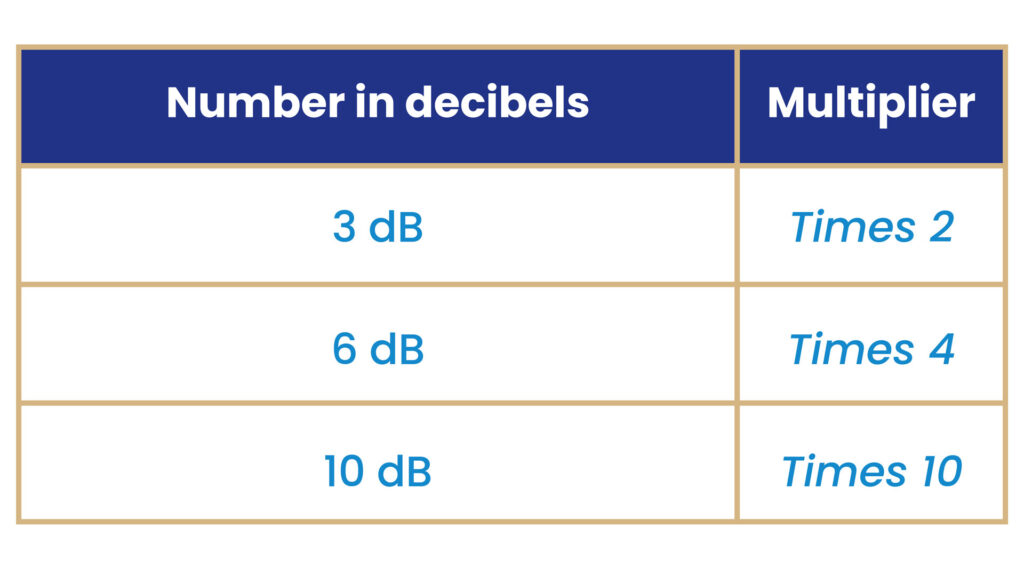
An increase of 3 dB means you have doubled your power, and a decrease of 3 dB means you have halved your power.
So when the exam asks which decibel value most closely represents a power increase from 5 watts to 10 watts, the answer is 3 dB, because this is double the power.
Decibels can also be added or subtracted together for easy math.
For example, let’s calculate how many decibels represent a decrease from 12 watts to 3 watts.
Starting with 12 watts, we can cut it in half to 6 watts, which is -3 dB.
Then we can cut that in half again from 6 watts to 3 watts, which is another -3 dB change.
Our total dB change is -6 dB – that’s our answer.
10 dB Means 10 Times the Power
Our second “magic” number is 10, which means 10 times. This one is even easier to remember.
An increase of 10 decibels means you have 10 times the power.
So, a power increase from 20 watts to 200 watts is 10 dB.
Lesson Recap
Let’s recap. In this lesson, you learned about the metric prefixes like kilo & mega that represent large numbers, and milli and micro which represent small numbers.
You learned how to convert units by moving the decimal point 3 places to the left or three places to the right, and how to check that you’re moving the decimal in the right direction using some common sense and logic.
Then, we discussed the decibel scale, which is used for signal gain and loss. The two magic numbers are 3 dB, which means doubling your signal, and 10 dB, which means 10 times your signal.