Ohm’s Law
Voltage, current, and resistance are all related by a formula called Ohm’s law, the most important formula in all of electronics, and you’re going to learn it now.
Ohm’s law states that voltage (E) equals current (I) multiplied by resistance (R).

In modern times, voltage is usually represented as a V, but on the test, voltage is represented with an E. Think “E” for “Electrical Potential”.
Using Ohm’s law, you can either calculate voltage, current, or resistance, as long as you have two of the three values. You just have to rearrange the formula.
Triangle Method for Solving Ohm’s Law
An easy trick to remember Ohm’s law and solve equations is the triangle method, using this triangle to represent the formula.
Voltage (E) is on the top, and current (I) and resistance (R) are on the bottom. As long as you remember that voltage is on top, you can remember this triangle for the exam.

To calculate any value, circle the value you want to calculate. Then, using the triangle, you can see if you need to multiply or divide the other two values.
Let’s say you want to calculate the voltage (E).
- First, circle the voltage (E)
- Then, notice that the current (I) is side by side with resistance (R), so draw a multiplication sign
- Now, you have your answer. To calculate voltage, the formula used is E = I x R.
Now let’s use the Ohm’s law triangle to find the formula for current.
- First, circle current (I)
- Notice that the voltage (E) is on top of Resistance (R), so add a division sign.
- Now, you have your answer. The formula to calculate current is I = E / R.
Calculating resistance is easy, following the same method.
- Circle the R for resistance
- Add a division sign
- The formula to calculate resistance is R = E / I.
Now let’s solve some equations using real numbers, when one of the values is missing. The trick to solving Ohm’s law equations is to figure out which value is missing, and then use the correct formula.
Calculating Voltage
Let’s start by calculating the voltage when we have current and resistance, using our formula E = I X R.

What is the voltage across a 2-ohm resistor if a current of 0.5 amperes flows through it?
Plugging this into our formula, we have:
- Voltage (E) = 2 x 0.5 = 1 volt.
Let’s try another one.
What is the voltage across a 10-ohm resistor with a current of 1 ampere? This one’s easy.
Voltage = 10 ohms times 1 ampere = 10 volts.
For a circuit with a 10-ohm resistor with 2 amperes flowing through it:
Voltage equals 10 ohms times 2 amperes = 20 volts.
Calculating Current
Now let’s calculate the current when we know the voltage and resistance. According to our formula, current (I) equals voltage (E) divided by resistance (R).

What is the current through a 100-ohm resistor connected across 200 volts?
Plugging this into our formula, we have:
- Current equals 200 volts divided by 100 ohms = 2 amperes.
Let’s try another one.
What is the current through a 24-ohm resistor connected across 240 volts?
- Current equals 240 volts divided by 24 ohms = 10 amperes.
What is the current in a circuit with an applied voltage of 120 volts and a resistance of 80 ohms?
- Current equals 120 volts divided by 80 ohms = 1.5 amperes.
Calculating Resistance
Now, let’s calculate the resistance when we have voltage and current.

Using our formula for resistance, we know that resistance (R), equals voltage (E) divided by current (I).
So what is the resistance of a circuit that draws 4 amperes from a 12-volt source?
Plugging this into our formula:
- Resistance = 12 volts divided by 4 amperes equals 3 ohms.
What is the resistance in a circuit with a current of 3 amperes connected to 90 volts?
Resistance = 90 volts divided by 3 amperes = 30 ohms.
For a circuit with an applied voltage of 12 volts and a current of 1.5 amperes:
Resistance = 12 volts divided by 1.5 amperes = 8 ohms.
Calculating Power
Another important formula in ham radio is the formula to calculate electrical power in a DC circuit, which is P = I x E.
Power, measured in watts, equals current times voltage. It’s a very simple formula, just like Ohm’s law, and we can solve equations for power in the same.
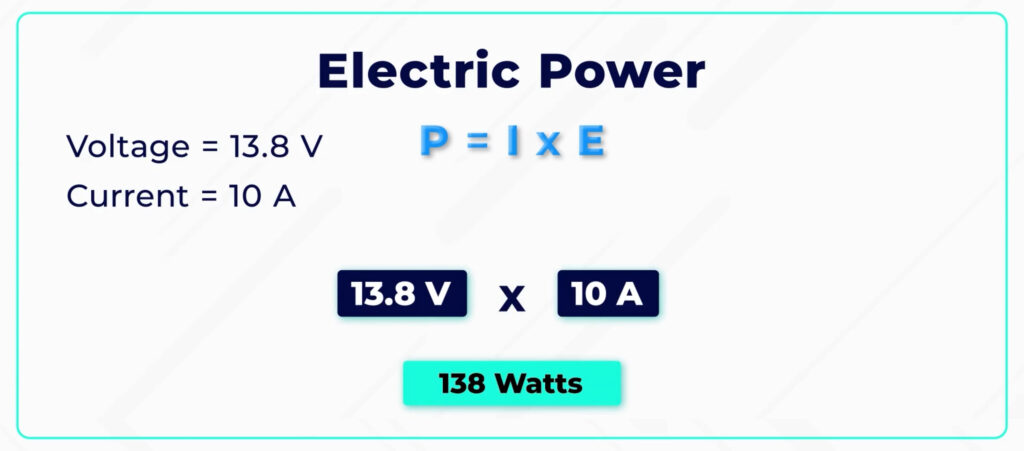
For example, how much power is delivered by a voltage of 13.8 volts DC and a current of 10 amperes?
Plugging this into our formula, we have:
- Power = 13.8 volts times 10 amperes = 138 watts.
Let’s do another one.
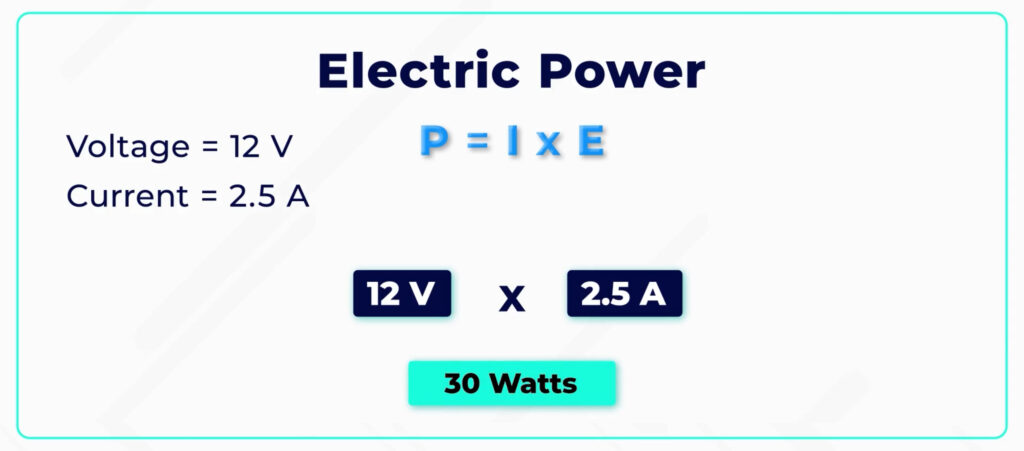
How much power is delivered by a voltage of 12 volts DC and a current of 2.5 amperes?
- Power = 12 volts times 2.5 amperes = 30 watts.
Let’s say you know the power in watts and the voltage, and you want to calculate the current.
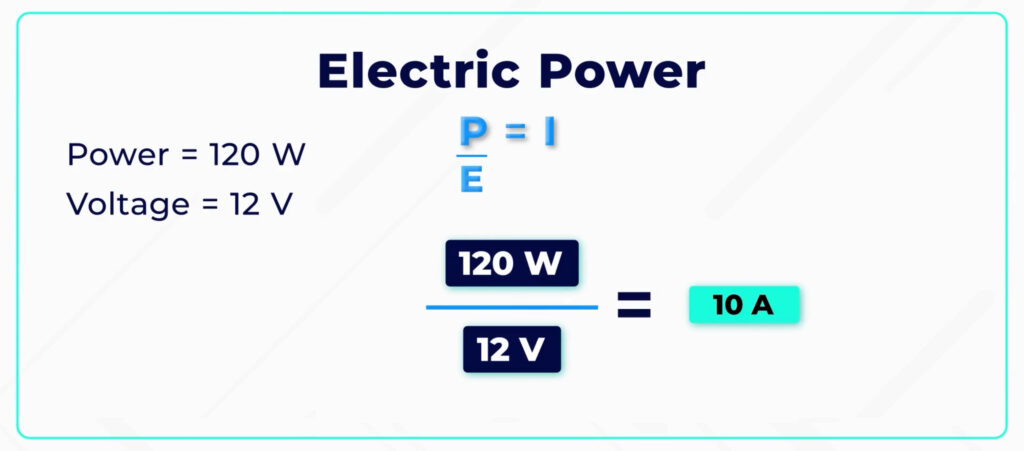
You can rearrange the power formula by dividing both sides by voltage (E), which shows that current (I) = power (P) divided by voltage (E).
So, how much current is required to deliver 120 watts at a voltage of 12 volts DC?
- Current (I) = 120 watts divided by 12 volts = 10 amperes.
Lesson Recap
Congratulations, in this lesson, you learned the most important law in all of electronics, Ohm’s law, which states that voltage (E) equals current (I) times Resistance (R).
You learned how to calculate voltage, current, and resistance when you have two of the three values, by rearranging the Ohm’s law formula to solve for the missing value.
Then, you learned how to calculate power with the formula Power (P) = Current (I) times Voltage (E).