Welcome back! In this lesson, you’ll learn about repeaters, the frequencies available to you with your Technician license, and the rules regarding transmit power. Let’s dive in.
Repeaters
A repeater station is a type of amateur station that simultaneously retransmits the signal of another station on a different channel or frequency.
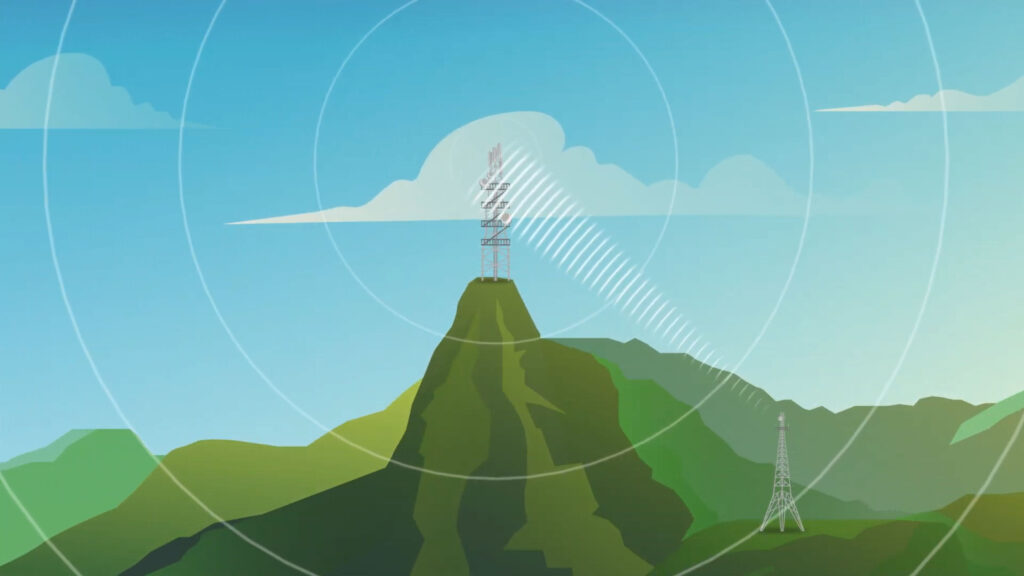
Repeater Station, Illustration by Ham Radio Prep
Many communities have a local ham radio repeater – you might have one near your home. Think of it like a cell tower, but specifically for ham radio. It receives your signal and repeats it over a longer range, usually between 25 to 100 miles, making repeaters great for local communications.
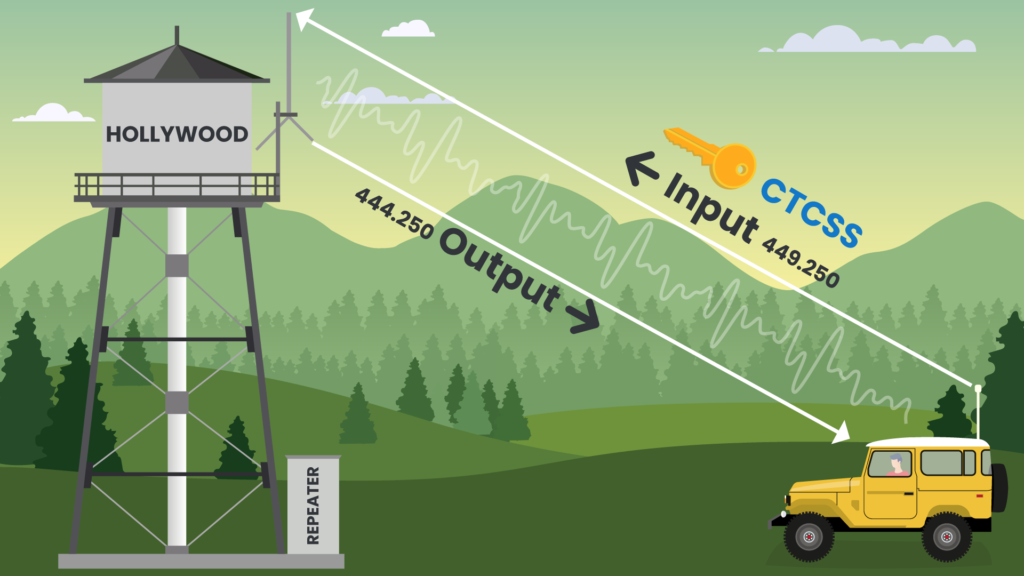
Local Ham Radio Repeater, Illustration by Ham Radio Prep
Many repeaters also have backup emergency power and can operate if the grid goes down.
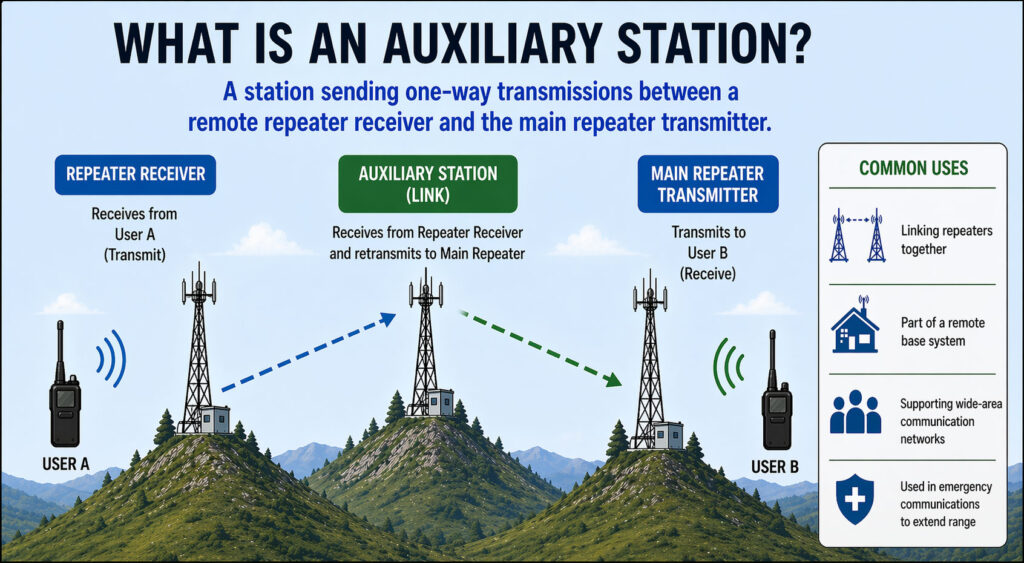
You can extend the range of ham radio repeaters even further by adding auxiliary stations and linking multiple repeaters together.
An “auxiliary station” is a station sending one-way transmissions between a remote repeater receiver and the main repeater transmitter.
So, how do ham radio operators choose the right transmit and receive frequencies for repeaters and auxiliary stations to avoid interference?
You might be surprised that the FCC doesn’t recommend the transmit or receive channels – it’s actually a Volunteer Frequency Coordinator recognized by local amateurs.
The Frequency Coordinator is selected by amateur operators in a local or regional area whose stations are eligible to be repeater or auxiliary stations.
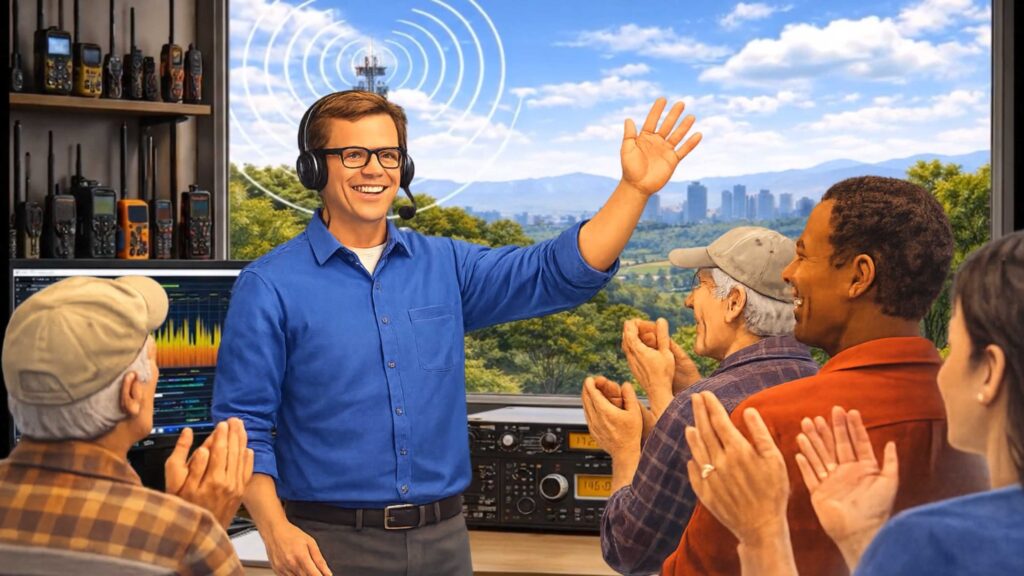
Volunteer Frequency Coordinator, Ham Radio Prep
It’s local amateurs – not the FCC or an international organization – that recommends the repeater channels.
Frequency and Band Basics
With your ham radio license, you’ll get access to a large range of frequencies.
A frequency is the number of times a radio wave repeats, or completes a cycle, in one second, measured in Hertz (Hz).
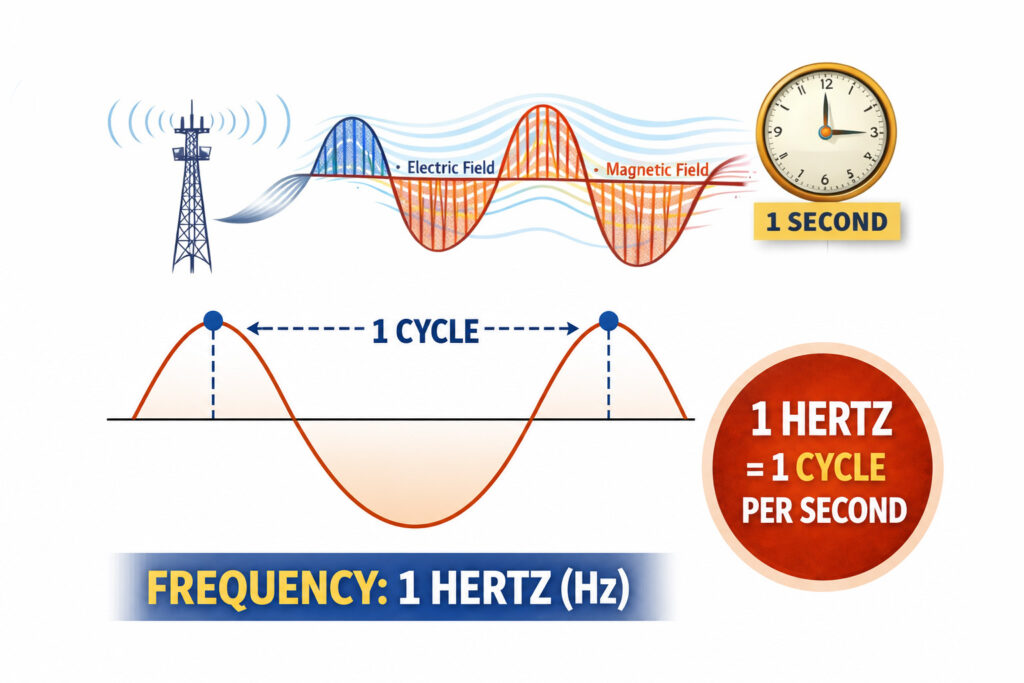
You can imagine a frequency like the vibrations of a guitar string. Some strings vibrate at a higher tone and other ones at a lower one.
Different frequencies have different properties. Some frequencies are best for local communications, some frequencies are best for long-range communications, and some frequencies even work better depending on the time of day.
To stay organized, we put ranges of frequencies into different bands, like 2 meters, 6 meters, 10 meters, 20 meters, and more.
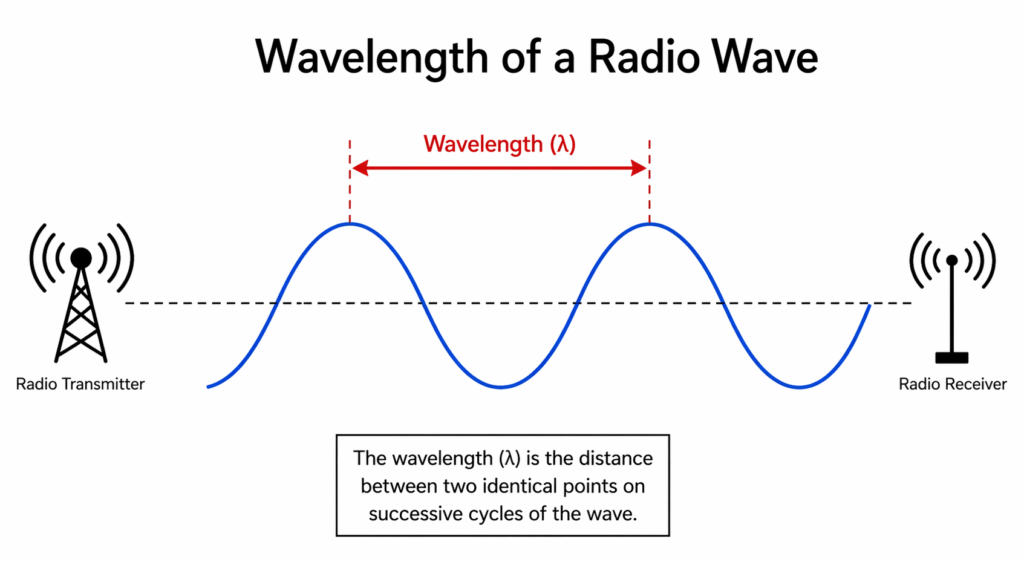
Bands are measured in meters because they are based on the approximate wavelength, which is the distance between two peaks of the radio wave. Frequency and wavelength are inversely related. As the wavelength gets longer, the frequency decreases.
To make it easy, ham radio operators use a band plan as a reference for all of the frequencies and bands in ham radio. A band plan shows you which frequencies you’re allowed to use depending on your level of license, and it also recommends what modes of operation to use on different frequencies, like voice, Morse code, or even digital, so we can effectively communicate.
When you first get your technician license, most of your privileges are on VHF and UHF frequencies, which stands for Very High Frequency and Ultra High Frequency.
In the VHF range, the two main bands are 2-meters and 6-meters.
The 2-meters band is great for local, short-range communications, and many repeaters use this band.
The 2-meters band includes the frequency of 146.52 MHz, which is also called the national calling frequency, one of the most famous and common frequencies in ham radio.
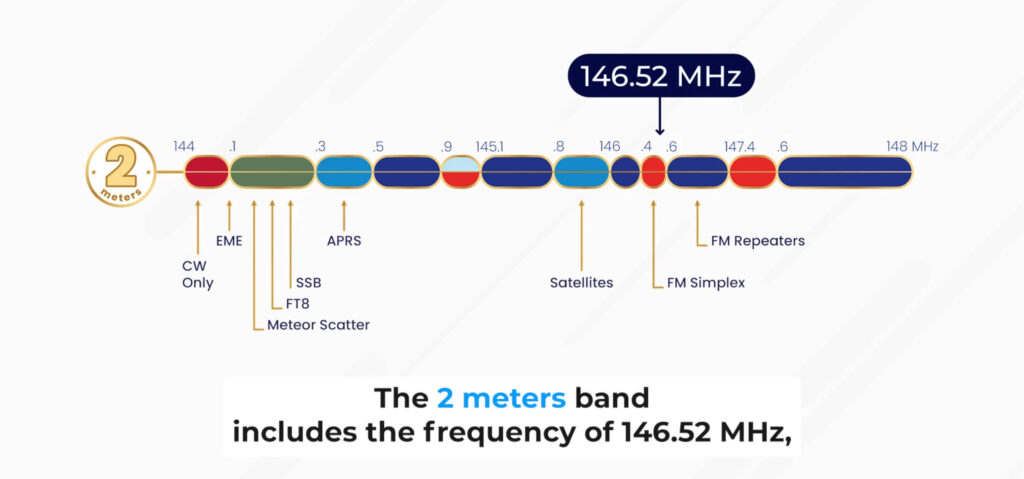
2-meters band explained, Illustration by Ham Radio Prep
Many ham radio operators monitor this frequency, so you can tune your radio to 146.52 MHz to look for local ham radio operators and make a contact.
The 2-meters band is usually used for local, short-range communications. 146.52 is a great frequency to use to make your first contact with a handheld, or to chat with other operators locally, and the 2-meters band is frequently used for repeaters.
With your tech license, you’ll also get access to the 6-meter band, which is around 50 MHz. The 6-meters band is sometimes called the magic band because it has special properties that allow both local communications, but sometimes, under the right conditions, can give you worldwide communications.
52.525 MHz is a frequency in the 6-meters band that is commonly monitored for direct radio-to-radio communications.
HF Bands
The HF bands, which stands for High Frequency, are very important in ham radio because they are most commonly used for long-range and even worldwide communications.
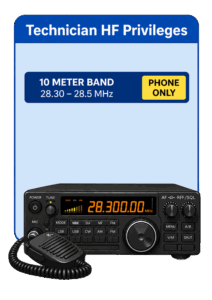
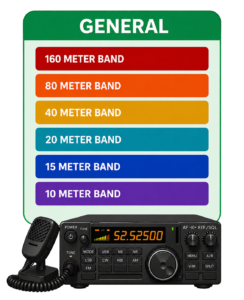
With your Technician license, the only HF privileges you have are phone privileges on the 10-meter band only. This is enough to get started with HF as a Technician, but one of the main reasons people upgrade to General is to get access to more HF bands.
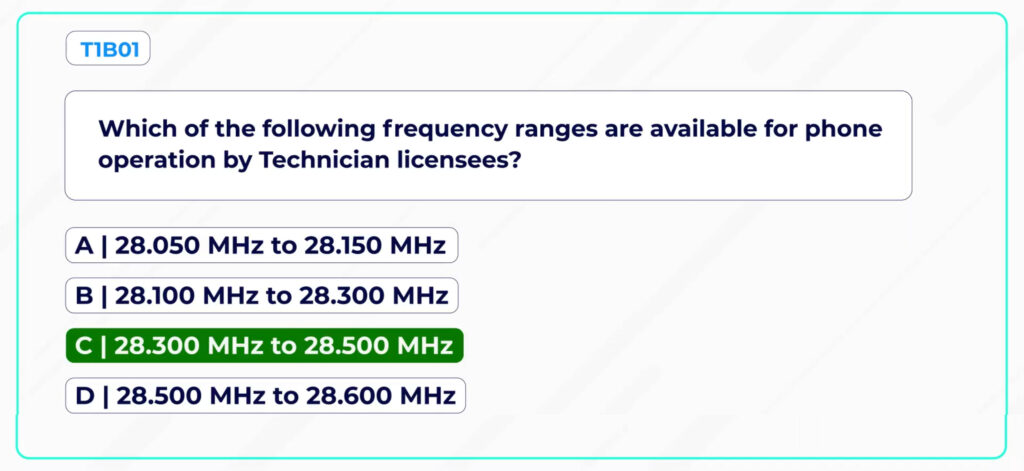
On the 10-meter band, Technicians have access for phone operation from 28.300 MHz to 28.500 MHz.
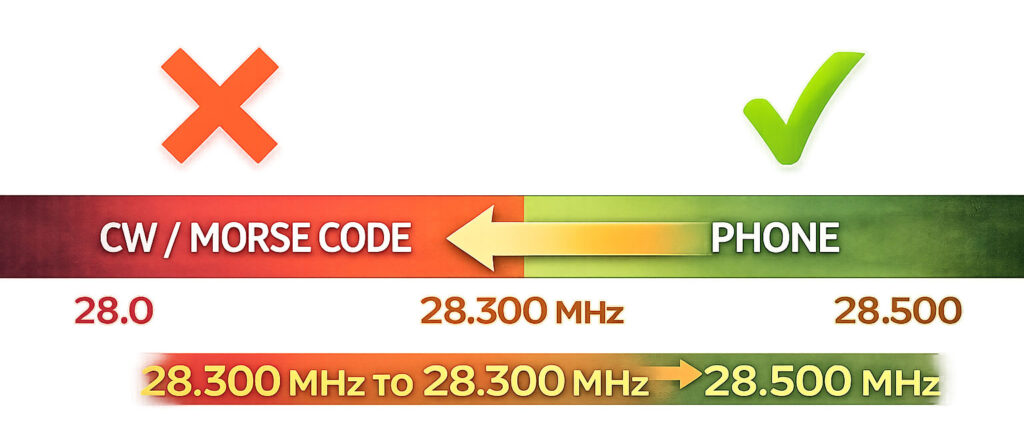
Here’s a tip to remember this answer. Band plans typically put CW, or Morse Code, at the bottom (lower frequencies) of the band, and phone higher up, so don’t choose the lower frequencies between 28.300 MHz to 28.500 MHz.
On the 6-meters and 2-meters bands, the bottom is also used for CW.
The 50.0 MHz to 50.1 MHz and 144.0 MHz to 144.1 MHz are VHF/UHF band segments that are limited to CW only.
In addition to phone and CW modes, ham radio operators also use digital modes to communicate.
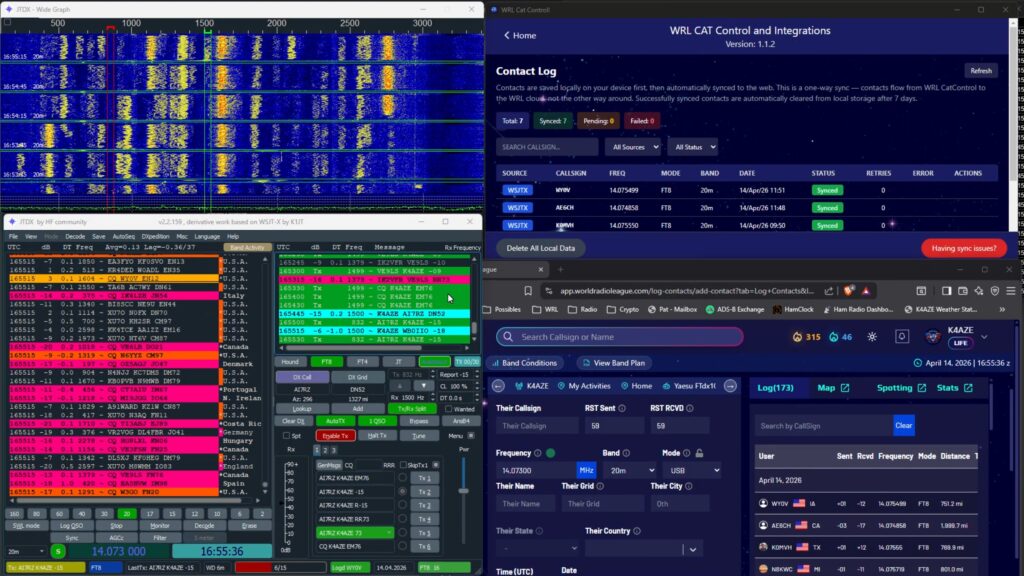
Screenshot of operating on FT8 (Digital mode), by Ham Radio Prep
Digital modes encode and decode messages with the help of a computer. A super popular one is called FT8. As a Technician, you are authorized to use FT8 on the 10-, 6-, and 2-meter bands. If you see a question asking about which bands you can use FT8, all these choices are correct.
There are two popular modes of operation on ham radio that both transmit your voice: FM and SSB.
- FM mode, or Frequency Modulation, is popular with handheld or mobile radio hams to talk with repeaters.
- SSB, or single sideband, is more typically used on HF bands. But, you’ll find an SSB phone allocation in at least some segment of all these bands above 50 MHz, which are the VHF and UHF bands.
Restrictions and Band Edges
On some of the ham radio bands, amateurs are considered secondary users. We even share allocation with military or government communications.
U.S. amateurs may find non-amateur stations in those segments, and must avoid interfering with them.
You also want to make sure not to go operate over the edges of the band into restricted frequencies.
For instance, the 2-meter band covers 144 to 148 MHz, so you want to be careful not to transmit lower than 144MHz or higher than 148 MHz, or you’ll be outside of the band.
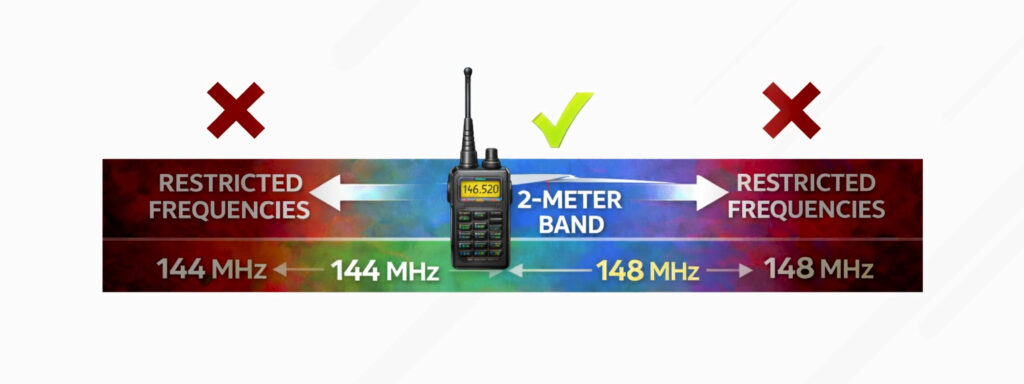
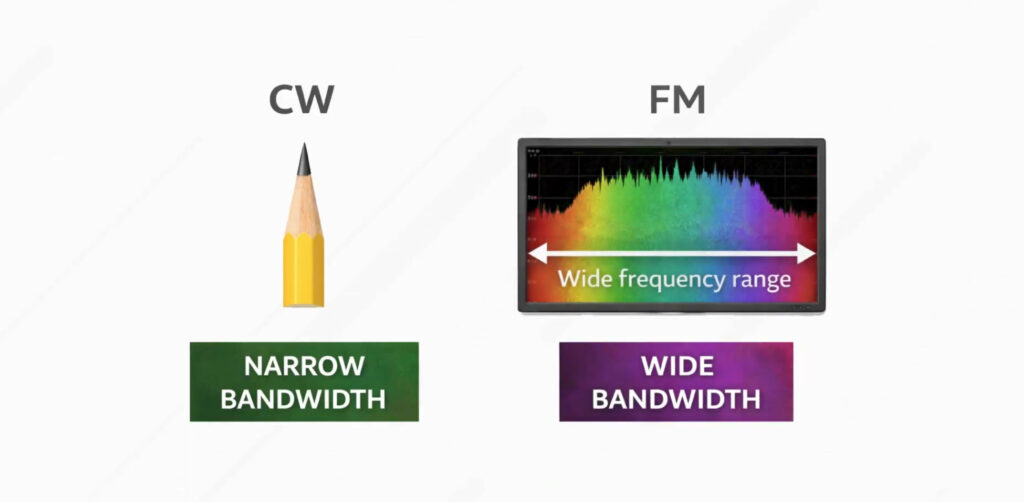
This can be tricky because each mode has a different amount of frequency it uses for its signal, known as the bandwidth. CW uses a very narrow range, like a pencil point, while others, like FM, use a wider frequency range.
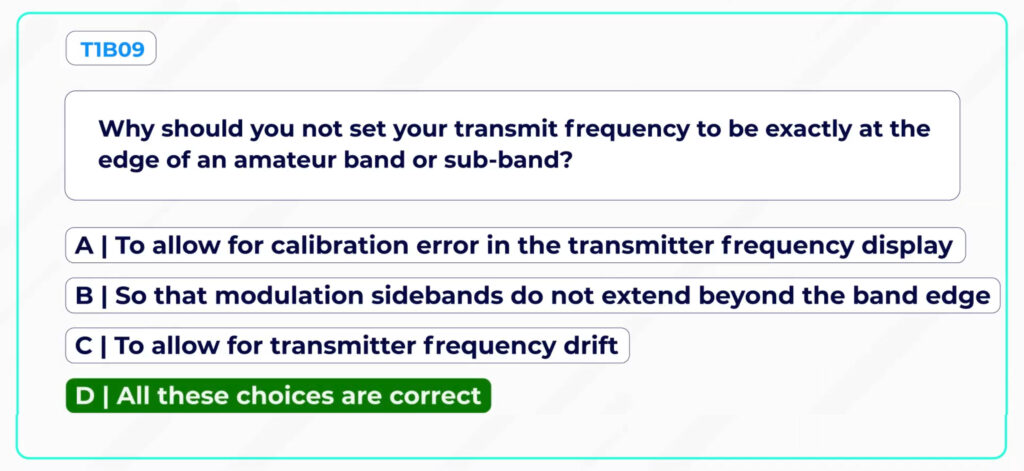
When you transmit, your signal extends a little above or below the displayed frequency. So, you shouldn’t set your transmit frequency to the band edge of 148.0 MHz and transmit; that signal will bleed outside the legal limit. Like using a marker and going outside the lines. Transmitting out of band is illegal and can interfere with other radio services.
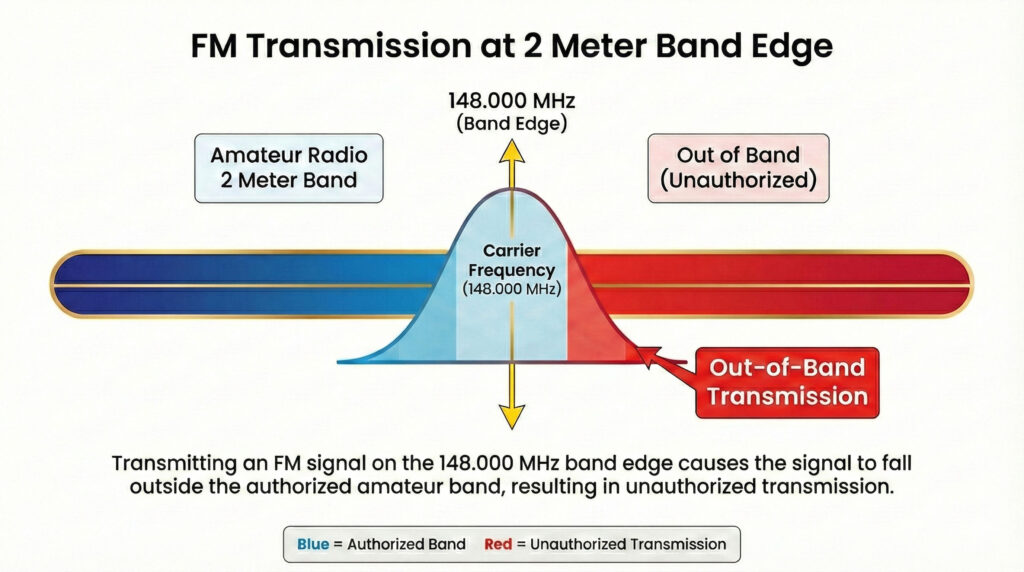
There are several reasons not to set your radio right at the band edge:
- To allow for calibration error in the transmitter frequency display
- To allow for transmitter frequency drift, and, as we said,
- So that the modulation sidebands do not extend beyond the band edge
When asked why you shouldn’t set your radio right at the band edge, all these choices are correct.
Power Limits
With your ham radio license, you’ll get access to transmit a lot more power than off-the-shelf non-licensed radios.
One way to measure transmit power is “Peak Envelope Power”, or PEP, which measures your signal at its strongest moment, not the average over time.
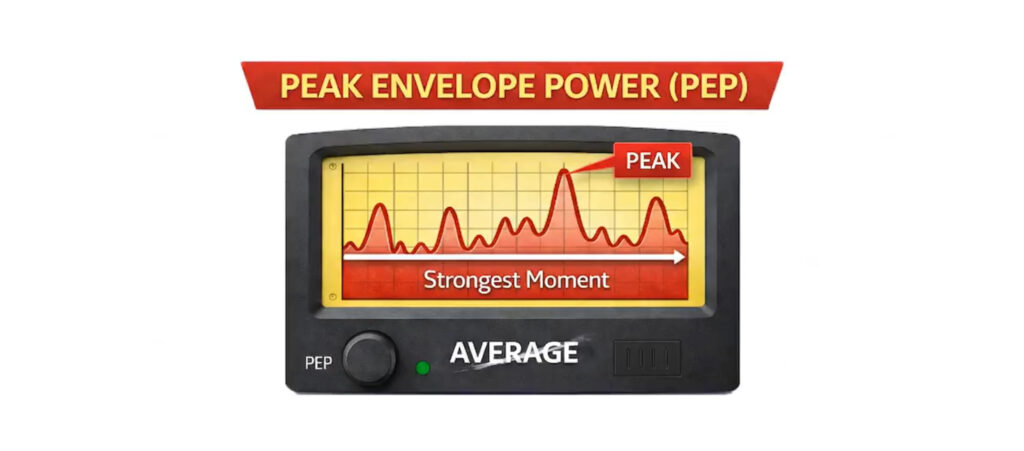
Typically, ham radio operators can use up to 1,500 Watts of power, PEP. That is 750 times more powerful than 2-watt handheld FRS radios off the shelf, and 125 times more powerful than the maximum 12 watts for CB radios.
With your technician license, you can transmit using up to 1500 watts of power for frequencies above 30 MHz, except for some specific restrictions. Those are the VHF and UHF frequencies.
However, Technician class operators are more limited on HF. For HF band segments, your maximum transmit power will be 200 watts.
When you upgrade to general, you’ll get higher power limits on the HF bands.
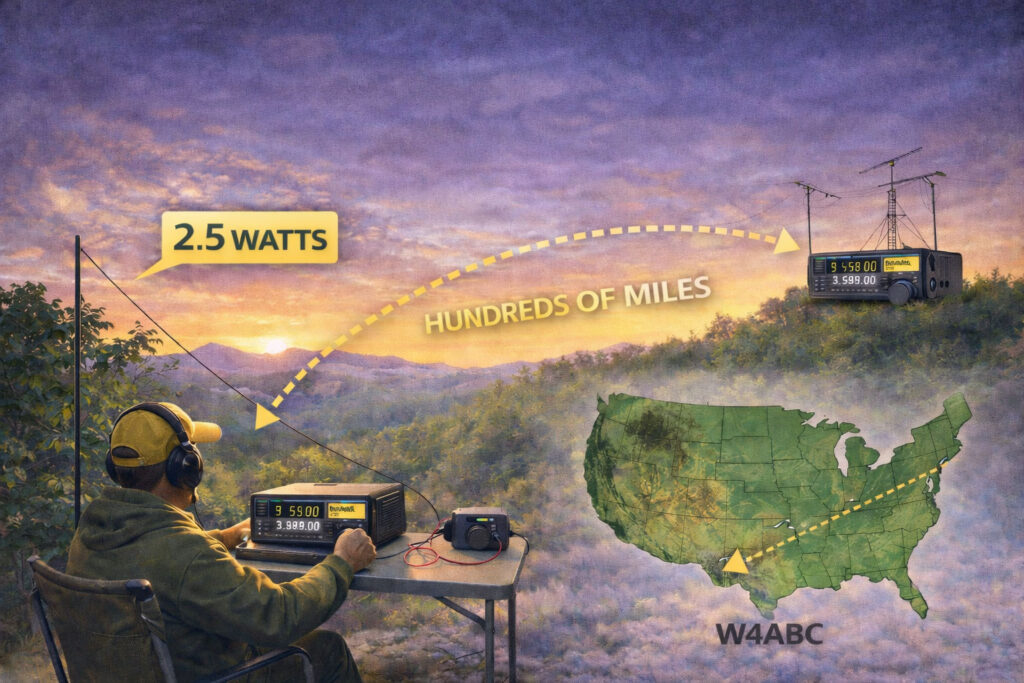
It’s also important to note that even though you can use as much as 1,500 watts, good operating practice is to always use the minimum power necessary to save energy and avoid interference. You’ll usually operate your handheld radio around 5 to 8 watts, and skilled operators can even make HF contacts hundreds of miles on just a couple of watts of power with the right setup.
Lesson Recap
In this lesson, we explored how repeaters and auxiliary stations extend your range and how volunteer frequency coordinators, not the FCC, choose repeater frequencies.
You learned that with your Technician License, you get most of your privileges on VHF and UHF, but you get access to HF on the 10-meter band only between 28.3 and 28.5 MHz.
You learned that 146.520 is the national calling frequency on the 2-meters band, and that the Technician license power limit is up to 1,500 watts of power PEP above 30 MHz, and 200 watts on HF.
Let’s take a break here. Read through the text lesson, then go practice with the quiz.
Quick Links: Download the Mobile App| Community Forum | Facebook Group | Reach us at [email protected] | Call Sign Search and Logbook